Food and Drink

Homemade Granola

Homemade Granola

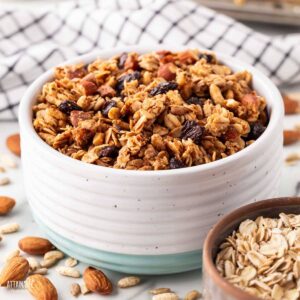
Packaged cereal has become a breakfast staple in America, but we gave it up long ago. In fact, we stopped buying cereal regularly long before I before I began this whole sustainable quest of mine, mostly because even after two (expensive) bowls full of cereal, my boys were hungry again by mid-morning. It just didn’t stick with them. Instead, I make homemade granola and I do it without a recipe. That means no measuring. Which means I can throw together a batch really quickly. Here’s how I do it: Oil the bottom of a large roasting pan to prevent sticking. Fill the pan to the halfway point with rolled oats. Add “extra” ingredients like puffed millet, chopped nuts, flaked coconut, or sesame seeds (whatever you have in the cupboard) so that the pan is about 3/4 full. Pour one-half to one cup of honey or maple syrup over the dry ingredients, stirring it in as you pour. Bake in an oven set between 300-350 (F) degrees. (The variable oven temperature allows you to cook the granola while you’ve got something else in the oven, making the most of your heat.) Stir every 10-15 minutes* for about an hour or...

Read more »

Avoiding GMOs in our Diet

Avoiding GMOs in our Diet

For hundreds of years American farmers have been growing crops, saving seeds from one year to plant the next. Remember Almanzo Wilder and his hidden wheat during The Long Winter? From seed potatoes to corn and wheat, keeping a portion of the crop to be planted for the next growing season is a perfect example of being self sufficient. Once a grower harvests his first crop, he or she will never have to purchase seeds again, barring any natural disasters That all changes though, when we add genetically engineered seeds into the mix. (Also called genetically modified organisms or GMOs.) There’s plenty of debate about the health and safety of GMO crops, but one thing is certain: crops that require farmers to purchase seeds from the patent owner every year are not sustainable. When we buy foods made from genetically engineered crops, we support the notion of unsustainable farming. (Who could have imagined such a concept a generation ago?) It’s estimated that 85% of America’s corn crops are genetically modified, 91% of soybeans, and 88% of cotton are genetically modified. Other genetically modified crops on the market include sugar beets, canola, cotton, and papaya. (There are questions about GMO squash, wheat, and...

Read more »

Local Food Event: Taste of the Hawaiian Range

Ginger Beef Stew

I did something kind of out of the ordinary this weekend. I went out to dinner. But this wasn’t just any dinner. It was the annual Taste of the Hawaiian Range, a Big Island food event that brings prominent chefs together with locally raised and produced food items. Thirty-five restaurants were on hand, each preparing an assigned cut of grass fed beef, mutton, or feral pig. It is a meat heavy event, this one. Attendees browse their way through booths, picking up small plates of a variety of dishes, giving them a chance to “dine” at some of Hawaii’s best restaurants. It was my first time attending, and I was wowed. The Hilton Waikoloa Village was packed with residents and visitors lining up to sample some of the island’s delicious fare. Our favorites included the ginger beef stew from Honolulu-based Umeke Market, the luscious feral pork tacos from Roy’s (topped with a sprinkle of what I think was a smoked salt), and the green papaya salad presented by the community college culinary students. There was lamb bacon, lilikoi-papaya sorbet, Kona coffee, goat sausage, island-grown blueberries, and ferments. The longest line, though? People waiting to sample the Rocky Mountain oysters. (I skipped...

Read more »

Trick: Brown Bananas

brown bananas

  If you’ve got overripe bananas but no time to whip up a batch of banana bread, stick them directly in the freezer. No need to peel them and put them in a plastic bag. When you’re ready to bake, put the frozen bananas – which will have turned an ugly dark brown – on a plate to thaw. Once thawed, simply cut off one end of the banana and squeeze the fruit out of the skin. The texture will be a bit runny but it’s perfect for blending into a batch of bread. No waste, no plastic. This post inspired by a conversation on the Attainable Sustainable Facebook page about the ridiculous concept of pre-peeled bananas. Yes, really.

Read more »

Stevia: How Sweet it is

Freshly harvested stevia

One of the plants that’s thriving in my oh-so-wet-and-rainy garden this year is stevia. It’s the first time I’ve grown it, so I’m pleased to see it do so well, but how to use it? For starters, just chewing on a fresh leaf gives a burst of sweetness that’s welcome when you’re trying to cut back on processed sugars. I’ve tried tossing a few fresh leaves in with hot tea, but don’t notice much in the way of sweetening with this method. I really wanted to have a go-to sweetener at the ready for tea and coffee, so I decided to try drying it, which was super simple to do. I stripped the leaves from the stems, cleaned them in a bowl of water, and took them for a spin in the salad spinner.

Read more »

Harvest Abundance: Kale

Harvest Abundance: Kale

While much of the nation is dealing with an abundance of zucchini and tomatoes, my most prolific crop at the moment is kale. As someone who doesn’t love cooked greens, this is a bit of a dilemma. My chickens get the leaves that succumb to bugs, but that still leaves me with a windfall of two varieties of vitamin-rich green leaves. Turns out I’m not the only one trying to figure out how to deal with prolific kale plants. On Facebook, Tina asked: Can you post kale recipes? I don’t have a clue what to do with it other than feed it to chickens. Let me tell you how I’m utilizing it. First and foremost, it goes in everything. I strip out the main stem, cut the leaf into small shreds, and then: Saute the leaves with a bit of olive oil and garlic until they’re tender, then add eggs for a breakfast scramble. I use two leaves for three eggs. No use overdoing it and making everyone hate kale. Stir into marinara sauce. Kale disappears beautifully in marinara sauce – I use 6-8 leaves for a big stock pot. The people who don’t love kale don’t even know...

Read more »

Creamy Radish Leaf Salad Dressing

Creamy Radish Leaf Salad Dressing

Sure, chickens love radish leaves, but it’s a shame to let the chickens have all the fun. I harvested a bunch of radishes from the garden earlier today and saved some of the greens to try this. Consensus? Pretty tasty! Creamy Radish Leaf Salad Dressing Greens from one bunch of radishes (about 1 cup) 1 clove garlic 3/4 cup sour cream 1/8 cup olive oil 2 tablespoons balsamic vinegar 1/2 teaspoon salt 1/2 teaspoon pepper Whir all ingredients together in a blender until smooth. Serve with salad or as a veggie dip. If you’ve got radishes aplenty, you might also want to try making radish leaf pesto.

Read more »

Guest Post: Muffin Tin Snacks on the Go

Guest Post: Muffin Tin Snacks on the Go

My friend, Brette Sember, has a new cookbook out! In The Muffin Tin Cookbook, she shares recipes for appetizers, side dishes, entrees, and dessert — all made in muffin tins. Today, though, she’s here to talk snacks. Here’s Brette. ### My kids are in their teens now, but I swear I still have crumbs at the bottom of my purse from all the snacks I’ve packed over the years. I’m still hitting the pantry for portable snacks before picking up youngest from school and shuttling him to lessons, practice, meetings, and medical appointments. Easy on the go snacks are like gold in my kitchen. But I don’t want anything packaged, processed, or that is not “real” food. My solution is to cook snacks in my muffin tins. Yes, muffin tins. Not only do they allow you to make individually portioned snacks, but silicone muffin tin liners are non-stick, colorful, and reusable—the perfect way to transport snacks. Muffin tin cooking is a great way to get kids interested in cooking and eating healthy foods, too. They love choosing the liners, arranging food in the cups, and seeing the transformation when it comes out of the oven. There’s something about food that is...

Read more »

Homemade Gluten Free Cheese Crackers

Homemade Gluten Free Cheese Crackers

  Fact: Cheez-Its are crap food. Fact: Cheez-Its aren’t even a food really. More like a food product. Fact: In spite of the fact that I haven’t eaten Cheez-Its in years, if I were stranded on a deserted island with only one kind of food, Cheez-Its would be right up there at the top of my wish list. So sue me. Awhile back (inspired by a recipe sent by Amanda from High Prairie Homestead) my sixteen-year-old son took it upon himself to try his hand at making homemade cheese crackers. He deemed them “awesome,” not to mention really easy to make. Trouble is, I follow a gluten free diet. And let me tell you: just smelling those homemade Cheez-It-like crackers just wasn’t cutting it. So I decided to attempt a gluten free version. The results? I would totally take these with me to a deserted island. Homemade Gluten Free Cheese Crackers makes roughly the equivalent of a small box of Cheez-Its (otherwise known as enough for me) ½ cup sorghum flour (plus more for rolling out dough) ¼ cup coconut flour 4 tablespoons cold unsalted butter, cut into small pieces 1 cup cheddar cheese (sharp or mild) ½ teaspoon...

Read more »

On the Bookshelf

On the Bookshelf

I’ve been reading books to inspire my lifestyle lately and these really impressed me. Farm City: The Education of an Urban Farmer by Novella Carpenter The idea of creating a productive urban farm in the less desirable parts of Oakland, California is mind boggling to me. But while the location freaks me out a little – I’ve been lost in the seedier parts of Oakland. It is a scary place. – the story is an honest look at the author’s efforts to raise her own food. It’s not always pretty, but her determination and resourcefulness move her toward her goal and will certainly give those interested in adopting this sort of lifestyle an intimate look at what it’s like to raise poultry in a small space, scrounge for materials, and create something from nothing. When I mentioned this title on Facebook, The Metropolitan Homestead said: I’ve read it, and honestly, it was one of the things that pushed me into seriously starting our homesteading activities. I always wanted to get back to this lifestyle, but didn’t’ think we could in the city. Her book changed that mindset for me. The author has just released a second book, The Essential...

Read more »

Join Me!

e-book

Free Email Alerts!

Click 'subscribe' once, then check your email for a confirmation message.

Welcome

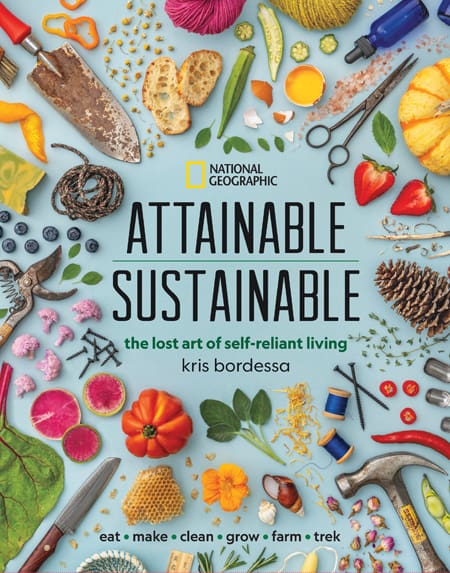
It’s one thing to think, “Hey, I’d love to be more self-sufficient!” and quite another to implement a lifestyle change that might require learning some new skills.

Attainable Sustainable is about bridging the gap between wanting change and making it happen without becoming overwhelmed. Nobody’s saying you have to go get a tractor and a cow. Attainable Sustainable is about discovering – one step at a time – how to make changes in your life to support a sustainable lifestyle.

The Author

Kris Bordessa has been gardening for most of her life. She's been authoring books and writing features for the past ten years or so. It's about time she combined the two, don't you think? [More about the author]