
Changing how we do things – adopting eco conscious habits – can make a huge impact on our environment and the sustainability of this planet. Tackle some of these easy to adopt changes!
Originally published in April 2013; this post has been updated.
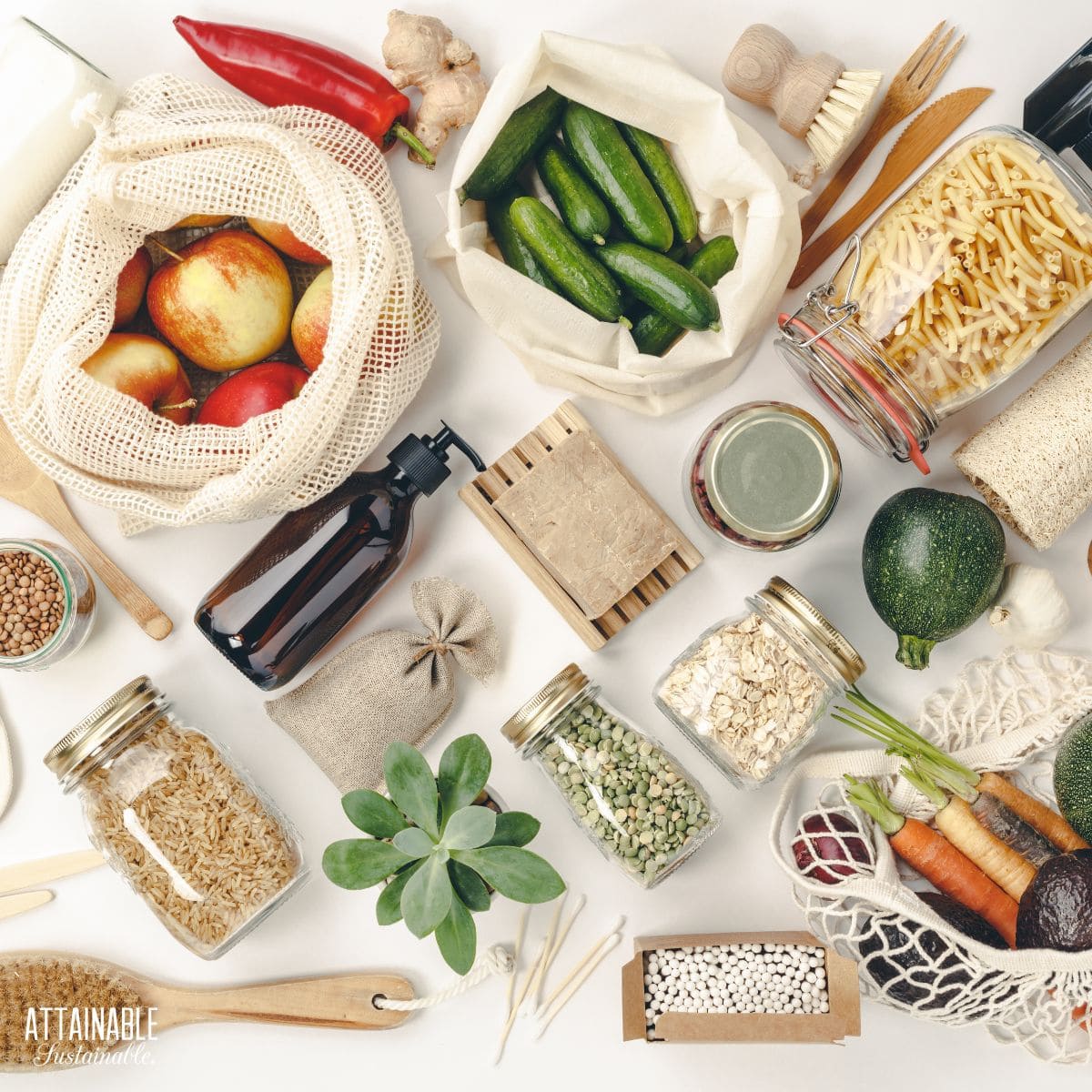
Adopting Eco-Friendly Habits is Not Hard
There are so many small things that can collectively make a difference in our footprint on the earth. Will you try to add one or more of these to your list of green living changes to tackle? Will you share this list with your family and friends or on your social networks?
Even people who are reluctant to step out of their comfort zone will find something here that they can embrace with relatively little effort. We just need to convince them that it needs to be done, and that adopting eco conscious habits truly is not painful.
Becoming conscious of the problem is the first step in making changes. Honestly, it requires an assessment of the way we do things. If it’s your habit to slip sandwiches into a disposable plastic sandwich bag, you might not think twice as you pack up lunches. But now that I’ve put the thought into your head that dropping a plastic baggie in the trash every day at the end of a meal might not be the greenest choice, maybe you’ll consider another alternative. Could you try a reusable plastic container? Or perhaps you’re ready to embrace beeswax wraps and try making your own.
Making Small Changes
Aiming for a more sustainable lifestyle? Making environmentally friendly choices is the least we can do to help ease climate change a tiny bit, but many of the suggestions you’ll find here will also help you save money over time!
Take a Peek Inside My Book!
Get a free excerpt from my book, Attainable Sustainable: The Lost Art of Self-Reliant Living! You’ll also get my free weekly newsletter, complete with recipes, gardening tips, and a little peek at what’s going on around here — both the zany and the mundane.
The list below is a start toward making sustainable change so that you can reduce your environmental footprint.

Living Greener in the Kitchen:
- Stop buying fruits and vegetables that have been imported from another country to reduce gas emissions and energy consumption caused by moving produce from one location to another.
- Buy real food. If you can’t trace its origin, it shouldn’t go into your body (ahem, IMHO) and it’s surely not doing our environment any good.
- Quit relying on takeout food. If you succumb, find a restaurant that uses compostable packaging and say no to plastic straws. Or better yet, bring your own containers for them to fill.
- Learn to cook some really simple, really fast meals so you won’t be tempted by fast food.
- Find a local butcher that uses butcher paper instead of buying your meat cuts on Styrofoam.
- Find a source for local meat and eggs for eco-friendly protein.
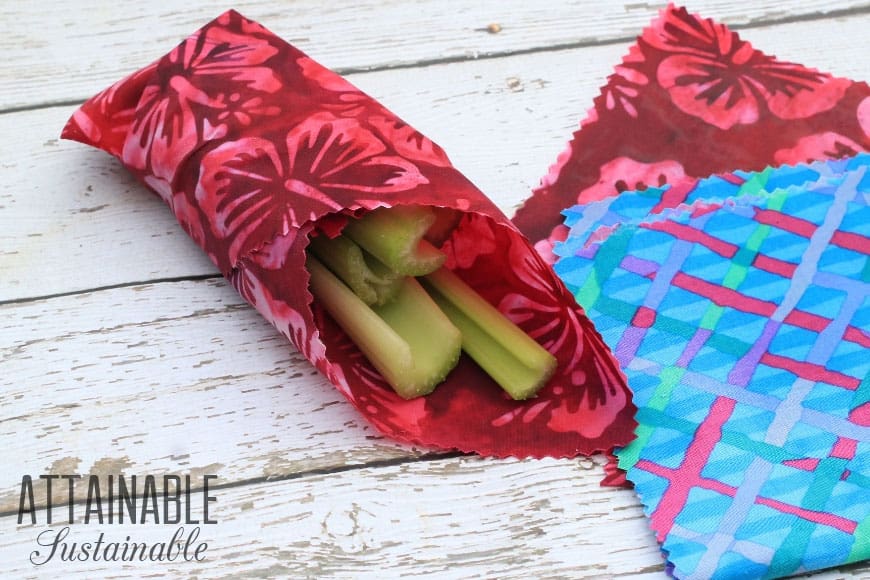
- Make a set of reusable beeswax wraps or snack bags to cut down on plastic waste. No time to make your own? They’re pretty readily available at natural food stores.
- Adopt these habits to limit your food waste.
- If you use a dishwasher, switch to a less-caustic detergent. Or make your own dishwasher soap tablets. If you wash dishes by hand, skip the disposable plastic bottles and make this homemade dish soap.
- Not ready to make your own homemade dish soap? Check out these solid dish soap bars – they’re entirely plant based and zero plastic!
- Use a dish cloth instead of a sponge. Or opt for a more eco-friendly natural sponge.
- Turn up the temperature on your refrigerator, just a touch.
- Switch to glass storage containers instead of plastic.
- Get rid of your Teflon coated pots and pans. Cast iron is just one option.
- Bring fewer containers into your home. Be sure to recycle those that you can’t reuse.
- Compost your food waste.
- Make your own salad dressing, mustard, mayonnaise, and other condiments. It’s not that hard.
- Cook double batches. Eat one lasagna tonight, freeze one for the crazy busy day that’s tempting you to turn to fast food.
- Switch to bulk teas that can be made with a tea strainer. No bags, no packaging, and no risk of ingesting plastic.
- Learn to make broth from bones.
- Swear off single use plastic. Just eliminating plastic water bottles can make a big difference. If you’re concerned about the quality of your water, consider investing in a big Berkey gravity-fed water filter.
- If you host dinner parties — small or large — adopt these eco conscious party ideas to create less waste.
The Eco Conscious Bathroom:
- Nix the chemical cleaners; opt for less harsh eco-friendly options.
- Take shorter showers. Less hot water used, less energy used.
- Switch to less chemically laden soaps and shampoos, or try your hand at making your own.
- Still using disposable razors? (Stores are still stocking them; somebody must be using them!) Switch to one with a replaceable blade.
- Try a fabric shower curtain instead of a plastic one.
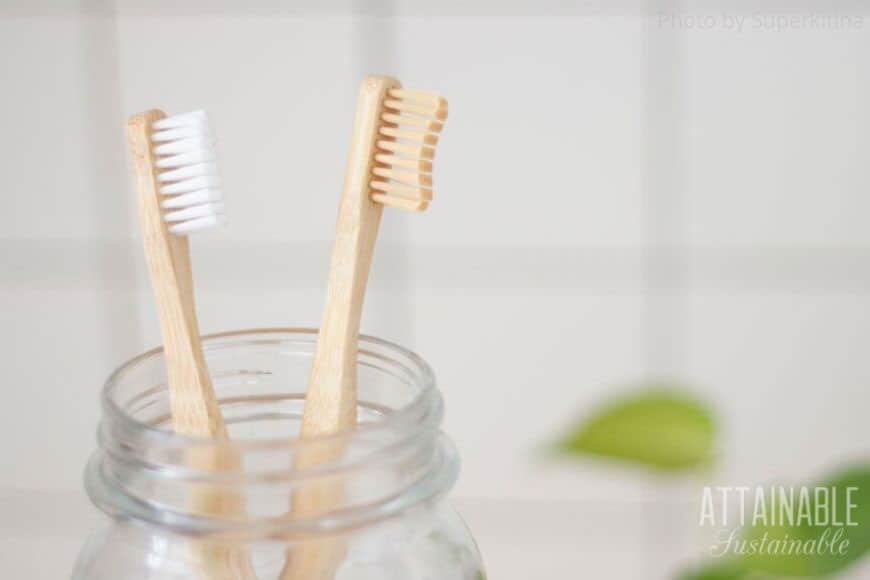
- Swap your plastic toothbrush for a compostable bamboo one.
- Switch to these toothpaste tablets to avoid the plastic toothpaste tube.
- If you use cotton swabs, make sure that you’re using those that are made of paperboard rather than plastic. They’ll break down easier in the landfill and can even be added to your compost.
- Instead of getting a fresh bath towel every time you shower, hang your damp towel up to dry and use it several times before you toss it in the laundry pile. Bonus: Your towels will last longer meaning you won’t have to replace them as often.
Eco-Friendly Habits in the Office:
- Switch to padded envelopes that don’t have a plastic bubble liner. It’s a painless and eco conscious change. If only we could get the United States Post Office to embrace this idea and go green!
- Stop junk mail before it gets to your house. I’ve had good luck subscribing to an app called Paper Karma, that allows you to take a photo of the junk mail you get and submit it for removal. (It’s a couple bucks a month, and I unsubscribe after a month or so.)
- Consider online banking. You’ll eliminate the envelope as well as the use of much fuel to get your payment where it needs to go.
- Opt to receive your monthly statements via email. Again, you’ll eliminate paper waste as well as fuel usage.
- Use public transportation. Not an option? Find someone to carpool with.
- Transform the water cooler at work: request paper rather than plastic cups. Better yet, encourage fellow employees to bring a cup from home.
- Refill your ink cartridges instead of buying a new one when the ink runs out.
- Not using your computer? Turn it off or put it to sleep.
Eco-Friendly Laundry Room:
- Only run the washing machine when you have a full load in order to save energy.
- Switch to a more eco-friendly cleaning products. Or make your own.
- Get clothes out of the dryer as soon as they’re dry, so you’re not tempted to “give them a little fluff.”
- Better yet, set up a clothesline and hang your clothes to dry some of the time.
- Install a timer on your hot water heater. It’s an eco friendly effort that will also save you some cash.
The Rest of the House:
- Find out where your power comes from. Is it generated by diesel? Coal? Wind? Knowing that your energy usage is tied directly to environmentally unfriendly sources might make it easier to improve your carbon footprint (good for the planet and your bank account).
- Say no to products that come in plastic clamshells.
- Keep a blanket on the sofa.
- Turn down the thermostat on your heater, just a touch (with that blanket, you won’t notice).
- Next time you need to buy linens and blankets, skip the man-made materials.
- Turn off the TV if you’re not watching it.
- Install window blinds as an eco-friendly effort to help keep the house cool in the summertime and warm in winter.
- Shop second hand. Fast fashion is a huge problem, both in the making and in the disposal of discarded clothing. You can be the person to divert some of it from the landfill.
- Wash your windows with newspaper instead of paper towels. Greener living AND a better shine.
- Stop recycling cardboard. Here’s how to use it in your garden instead.
- When it’s time to shop for a new mattress, consider opting for an organic mattress that is free of polyester, polyurethane, and toxic fire retardants.
Outside:
- If you have an arbor, plant a deciduous vine that will shade you in the summertime and allow sunlight and warmth in during the cold winter. This can cut your energy usage, making your home more eco-friendly.
- Grow your own food. If you’ve never done so, start small. Plant radishes. Or lettuce.
- If you’re a gardening veteran, consider sharing your knowledge with amateurs.
- Plant an extra row for the food bank. It’s eco conscious and community-minded.
- Collect some of your rainwater and use it to water the garden during dry spells.
- If you’re still maintaining your lawn using chemicals, stop! (Now, wasn’t that easy? Think how much time I just saved you!) The U.S. Environmental Protection Agency estimates that U.S. households use nearly 90 million pounds of herbicides and pesticides on their lawns each year. Those chemicals end up in our groundwater and run off into rivers and oceans. If growing your own food is on your sustainability agenda, you certainly don’t want those poisons ending up on your kitchen table via the vegetables you grow. Read this for more information.
- If you regularly forget to turn off your porch or garage light, set it up on a timer.
- Deal with pests and weeds without chemicals.
- Mulch. It will help hold moisture in, and mean less water used. It will also help keep the weeds in check.
- Compost your kitchen waste. No space? Get worms to do the dirty work with a worm composter. (You can make your own for less than $5.)
Eco Conscious Living Around Town:
- Stop accepting the plastic bags that stores offer and bring your own.
- Switch from plastic to glass bottles when buying goods at the grocery store. If it’s only available in plastic, skip it (bonus points for writing to the manufacturer to complain).
- Say no to drinking straws. Get it the habit of telling your server ahead of time that you don’t want a plastic straw.
- Choose fruits and vegetables that are sold loose. There’s absolutely no reason for peas, peppers, or tomatoes to be wrapped in plastic or strapped to Styrofoam.
- Seek out local produce at the supermarket or (better yet) farmers market.
- Eliminate excess baggage in your car. If you don’t need to carry it around, don’t. You’ll use less gas.
- Take your own insulated mug for your coffee stops. Most coffee shops are happy to serve their patrons coffee in a reusable container, and some even offer a slight discount. By some counts, 14.4 billion cups of coffee are bought in disposable paper cups each year. Placed end-to-end, they say, these cups would wrap around the earth 55 times and weigh around 900 million pounds. How’s that for inspiration to change?
- Ditto a reusable bottle so you can eliminate single use plastic bottles.
- Combining errands so that you use less fuel is a smart eco conscious move.
- Live near town? Walk, sometimes!
- Seek out one wild food source in your area. Maybe it’s dandelion greens. Or maybe you’ve got a source for wild asparagus or blackberries.
- Go meet your neighbors. Having a friendly community means a chance to share equipment rather than everyone owning the same snow blower or tractor.
- Those same neighbors? May share their garden surplus or help you tackle all of those excess zucchini.
- Think about needs versus wants. We’ve become a society of shoppers. Do you really need that new pair of shoes?
- Choosing to live with less stuff is simply more eco-friendly.
- Be sure to read Bill McKibben’s Eaarth: Making a Life on a Tough New Planet.
Got another simple change to add for a more eco conscious home? Please share more eco-friendly habits in the comments! Together we can make a positive impact, reduce our use of fossil fuels, and improve energy efficiency.





I love awnings on windows and porches. They shade the windows so the glass doesn’t heat up and add heat to the house and keep the house much cooler in summer. A hassel to put up and take down but can be worth it I think.
I am pretty new here. I did offer this info before but I think it needs to be shared again. I broke my hip a bit over a yr ago & of course, it was life- changing. I still am healing & life has new challenges. I now do have my own garden. Yes, and I now have a worm farm. I am putting in a greenhouse little by little. I might add also, I do my own cooking & not only is that a new challenge but also, I might add, the food is good!! My next step is making my envirorment a healthy place for bees. I have just learned that bees love a colorful place too. I am learning what colors I can find in the plants I will plant or purchase. I do microgreens also & just today I havested a lot of good green organic veggies. A part of that went into a soup. TASTY too!! Although my injury did set me back, u can hardly notice it!! Life is good!! Thanks
Love this!
We have a large south-facing window in our living room. outside we have several Tamarack trees (American Larch). These are the only fir tree that are not evergreen. They drop their needles in the winter. So in the Summer they help shield our south side from too much sun, and in the winter they drop their needles and let the warmth of the sun heat our home. On a sunny winter day, our furnace won’t turn on until the sun sets. I purchased some stainless steel straws because they came with a straw cleaning brush. I works great on the flexible straws that come with some reusable cups. We do grow and preserve as much food as possible; and we cook from scratch most nights as well. We rarely eat out.
No thanks. Sounds like extra work and money. I have to buy cheap not local grown stuff that costs an arm and a leg. It’s easy for you rich jerks to do all this when money is not an issue.
Quite the opposite, actually. Most of the time, eco-friendly can mean cheaper, because it all boils down to “consume less”, whether it is by not buying disposables, spend less on gas or electricity, or simply not buying extra unneeded stuff.
Such a great list! One item I didn’t see was fabric softener/ dryer sheets. I recently made reusable wool dryer balls from wool yarn. I use 4 or 5 in my dryer, add a drop of my favorite essential oil and dry as normal. My laundry smells great, dries a little quicker and best of all no wasteful softener jugs, used dryers sheets, or harmful chemicals!
Good idea! I’ve long used vinegar as laundry softener.
Switch wherever possible to permeable outdoor hardscape. That is, instead of pouring great sheets of new concrete for walkways, driveways, etc., use “urbanite,” re-purposed concrete scrap from demolition. It’s usually free, because builders just want to get rid of it, and they have to pay to dump it in landfill. Hardscape (stone, brick, concrete, etc.) like this allows for more natural air and water passage between the soil and air, and doesn’t trap as much heat in the summer. Chosen ground covers like moss or thyme, or wild plants can grow in the cracks, creating healthier soil and a cooler environment. Permeable hardscape in retaining walls also stands up better to tremors, and when you live on the Pacific Ring of Fire (around the Pacific Ocean), that means a lot less repairs.
We already do many of these things. Some we can’t because of where we live (6 miles from anywhere), but we try. One that endlessly frustrates me is that Louisiana has zero glass recycling facilities. None. And they are extremely limited in their other recycling.
This summer, we are building a biogas generator for our house. No more supporting the big electric company or worrying about how our home is powered.
Finally, I’d suggest switching to all LED lights in your home. It reduces the heat in your home in summer, lowers your electric consumption, and the bulbs last years longer than most.
Choose not to reproduce. Our planet has enough humans already.
Animal husbandry is responsible for 51% of greenhouse gases. A simple way to reduce your carbon footprint is to eat less meat, better still come a vegetarian best of all go vegan.
Use family wipes instead of tp. Make your own maxi pads. Use envelopes from discarded mail to dran grease from bacon.
Good ones.
Love this article! I really want to try and minimise my waste and have been doing lots of research lately and this article is honestly the best I’ve read! Thank you for sharing it!
Excellent!
And stop eating cows. Cow farts (AKA methane) are one of the biggest sources of greenhouse gasses causing climate change.
Even people who don’t want to eliminate beef entirely from their diet can reduce the amount they eat and skip beef that’s been raised in a CAFO situation.
This is something I can do to help the planet!
Concerning straws: I use stainless steel straws I ordered from amazon.com. I am a straw junkie and have been one who saves straws that I get in drinks, etc. Things don’t get thrown away in my house. However, I do not like to use plastic if I don’t have to. That’s why I have stainless steel ones. I always wanted the straight straws (no bend) but only could find the ones with a bend that are stainless steel until now. I found straight ones and am very happy with them.
Also, some stores give you a choice of plastic bags or paper. I always choose paper. The bag boy starts to use the plastic while asking me if plastic is ok. I tell him I prefer paper now, so they cater to that. Some stores, like Trader Joe’s, only use paper. If everyone starts choosing paper at the stores where both plastic and paper are an option, then the stores will lean more toward using paper.
Have you considered starting to carry your own reusable shopping bags? It takes some practice, but I almost always remember mine now!
When I travel to new places my “souvenir” is always a new reusable shopping bag with a nice or memorable logo on it. That way I get a nice reminder of my trip each time I use them and they are sometimes a conversation starter so I can encourage others to start bringing their own. I also give reusable bags as gifts, a gentle hint.
A lot of great ideas, but I sorely missed “go vegetarian or at least reduce the amount of animal products you consume weekly”.
A lot of great ideas, but I sorely missed “go vegetarian or at least reduce how many times a week yu consume animal products”.
In Australia use website lasoo to source store weekly specials rather than having paper ones dropped in your mail box
“Use bath towels more than once.” That is what we have always done. Each person in the house gets their own towels and wash cloth color or pattern, so you know who did not hang their’s up. We use a coat rack with lots of hooks so each person gets their own hook. The rack is located above the heat/air vent so you get warm towels in the winter and cool in the summer and the air blowing up them dries them faster.
We had a visitor here a few years ago and he put his towel in the laundry after *every shower. I was blown away.
Two things…my plastic shower curtain came w a label indicating it was free of most chemicals. So I am going to lay it down as a base for raised beds. Secondly, my step mother dries her clothes for only half the time, gets them out of the dryer still damps, and puts them on hangers on the bathroom and elsewhere. Great suggestions, thank you.
I do the opposite – I’ll often hang clothes to dry then finish up with a quick tumble. We live in a very humid climate and they never *quite get dry on the line most days.
Switching from plastic bottles to glass bottles makes very little sense from an environmental stand point or a economical one. Glass is heavier then plastic so to ship the same amount of product is a lot of extra weight which means more fuel consumed to travel the same distance. Glass bottles also can break easier during transport so more product gets wasted
No, it does make every sense to do so. Being able to ship materials for recycling is not the ultimate challenge we are facing but rather the the fact that glass is a better material to recycle as its quality remains unaffected while it being infinitely recyclable. Plastic on the other hand goes down a lower level in terms of quality. And even if both of them end up in a landfill, glass is not going to create water, air or soil pollution where as plastic is going to leach into these and would harm the environment. There is a reason why glass is called environment friendly and not plastic.
Glass is my preference, but I still think that we can *reduce the amount of glass brought into our homes, thus needing to be recycled.
We garden. We start our plants indoors in early spring. Instead of buying containers to start our plants, I save cans with cutable bottoms. When the plants are ready to go into the garden, I cut the bottom out of the can and plant the can. It can be removed later, but the can itself will protect the roots from root eating worms.
“Switch from plastic to glass bottles when buying goods at the grocery store. If it’s only available in plastic, skip it (bonus points for writing to the manufacturer to complain).”
We’re having a community discussion about this right now. A letter in the local paper expressed the outrage of the writer who learned from a conversation with a truck driver emptying the dumpster that the only glass recycler in town (Target) actually winds up sending most of the glass to local landfill. This is primarily because many people tossed in garbage and/or other recyclables, or didn’t remove metal or plastic bands that remain after the lid is twisted off glass bottles/jars. Now, diligent, devoted local environmentalists have doubled down on how to make glass recycling REALLY WORK here. It’s a tough issue.
It IS a tough issue. We live on an island that ships all of its recycling off to SE Asia or the Pacific Northwest. I know it’s difficult in other regions, too. I think the best solution is to avoid buying disposable packaging at all, no matter the content, but that’s not always going to happen.
Thought the article had great suggestions. But it raised a question in me…when getting rid of some of these less green items, i.e.: plastic shower curtain, it occurs to me that in some areas it may not be a recyclable item. The question then becomes, what to do with the item so that it stays out of a landfill and contributing to anti-green activities. Do you have any suggestions?
Personally, if I have “questionable” items at home, I don’t just get rid of them for the sake of going green. It doesn’t make sense to add them to the landfill if they’re still functioning. But when a plastic shower curtain, say, is no longer working in the bathroom, repurposing it to get another use out of it before it goes to the landfill would be good. Can it be used as a drop cloth for painting? A tarp in the garden?
When I switched to a fabric shower curtain (the vinyl ones are terrible for people with breathing issues, I used my old curtain in the garden, for quite some time. It worked great to hauls stuff off to the compost pile for example. My mother was a Tupperware dealer when I was growing up, so I have more Tupperware then most people. The thing is it is reusable not disposable, it is also warrantied for life. So not only will they replace your item they will send you the latest version if they don’t make the mold anymore. Seriously, if you get an old piece at a yard sale but it has a small chip, you can call them and get the piece replaced, free. The point is to not use disposable containers and to use items that have a long lifespan. I also use vintage pyrex.
I switched from Paper Towels and paper napkins to cloth napkins and/or rags. My three kids and hubby would go through a roll every few days. At $1 a roll that not only hurts my pocketbook but the environment.
I hid the paper towels and made the cloth napkins accessible and I can’t believe how much money I save a year. I think it is close to $120 a year!
Turning the brightness down on electronic devices or on auto-brightness, more if you’re indoors or in a dim place.
Great ideas! As far as power sources, there are also programs that allow you to choose how much green power you want to use as a percentage of your total power. And to add another idea, when you are using a floor fan or other type of fan to keep cool (instead of the ac) you can place a bowl of ice in front of it for some extra coolness. Works great.
Already do much that’s on this list (and feel guilty if/when I don’t). Striving to do better, not perfection, which I think can put some people off from going greener in the first place. And there’s often a solution (like hanging your clothes inside in cooler months) that may not be apparent at first. Especially love: grow an extra row for the food bank. There’s a place — growing my own food — where I could do more.
I like the idea of doing one a day even, and rotating down the list. Such a great idea, Kris!
You go girl. I LOVE this! Love it. I couldn’t agree more with all of these recommendations. If we ALL did just SOME of them, the changes would be enormous to the entire planet. Poor Gaia. We humans are abusing her so…
So many of these tips are not just good for the environment, they up your efficiency too–like keeping laundry loads full, shorter showers, etc. This year I’m trying to plan ahead more to cut down on packaged foods–wheat berries prepared for breakfast (like your overnight oatmeal), making beans from scratch instead of relying on cans.
a thoughtful list, Kris. especially liked the reminder ‘plant another row for the food bank.’
Great list minus one problem. A lot of the list calls for you to “switch from… to … the act of switching out something you already have is in itself wasteful. unless of course you find someone willing to take them off your hand.
Dustin, good point. In no way do I mean to suggest that we pitch out everything we have and start fresh. But, for example, when the need to ship something arises, and the purchase of a shipping envelope is required, I hope that folks will consider an envelope padded with shredded paper rather than bubble wrap. Using what we have? Brilliant? Changing the way we consume? Necessary.
Skip the shredded paper when shipping. Use air popped popcorn. The receiver can feed it to the birds or livestock. It can be composted.
What an awesome list! Especially love the last one – I’ve been tearing my office apart, re-organizing, decluttering, and tossing/re-using/recycling.
Hi, Thanks for a great year of inspiration and wonderful green ideas – I’ve learnt so much. I did a year in review at NZ Ecochick and would love it if you would link up some of your favourite posts of 2011. Have a wonderful new year. M xx
A long time ago, I was very sick. I struggled everyday just to get through the day. I was ready to give up. I had a conversation with an old soul in a very young man’s body. I told him that I didn’t know how I was going to make it. He suggested that I try to make just one thing better every day. He challenged me that if I did that (just one thing better) where would I be in five years. It’s been fifteen years since that one conversation changed how I look at life. One thing better, it’s easier than you think. Try it and see for a month.
Joyce, that sounds like one sharp young man! Thanks for sharing.
Mahalo for compiling this comprehensive list, Kris. Many of us miss doing the doable thinking that it is too much trouble, without thinking about the results of our careless actions…
Such a great list. I do most of the above already. I think the one about meeting the neighbors is important, but it should be extended to spreading the word to those neighbors and, in general, beyond. And, writing to legislators. I listened to our local state senator Dan Wolf last night, as he told Mindy Todd on Cape & Islands radio about his priorities for 2012. He also said he plans to attend house parties informal gathering where constituents can tell him what matters to them. Ie. Conversation. Spreading the word. We need to keep raising the issue of the environment to our legislators so that they understand how very much it matters to us. I blogged about plastic bags this morning. Will now go back in and link this great list to my post so that my readers can have it, too. Thanks!
Thank you! I try to talk about this with people, but gently. Some are interested, others tune me out. I try to respect that some just don’t want to hear it – for those, I think it’s a matter of leading by example as best I can!
Brilliant list!!! Even as an eco-conscious family, it still amazes me the amount of waste that filters through our home. It does require constant intentionality. Thank you for these great suggestions.
It’s almost as if the more aware and careful we get, the more aware we are of what we can improve upon. That’s a good thing, though, I think!
I use a rain barrel that comes off my barn to water the chickens, only downside is it freezes in the winter.Use a old coffee can for veggie ends to go out to chickens or compost. Shred your paper and put in compost pile or use it for bedding.
Gathering rainwater for the chickens is a great idea to save a step – at least in non-freezing weather, eh?
What a useful lists, some really great ideas 🙂
What a fabulous, thoughtful list. Thanks for all these wonderful reminders. I wish I could hang my clothes outside to dry all year long…but I’m afraid much of the time I’d come away with frozen towels!
Use indoor drying racks when you can’t hang them outside. If you put them near a heater vent as they dry, the air gets humidified, which makes you feel warmer and helps with dry skin and dry sinuses! 🙂
My neighborhood doesn’t “allow” cltheslines, so I use drying racks year round!! Clothes last longer, colors stay brighter, and I’m helping Mother Earth a wee bit.
Good for you!
Fantastic post. Thanks so much for this. I’m going to share it on NZ Ecochick’s facebook page. I do most of these things but it’s great to pick up some new tips.