
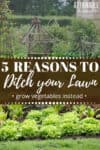
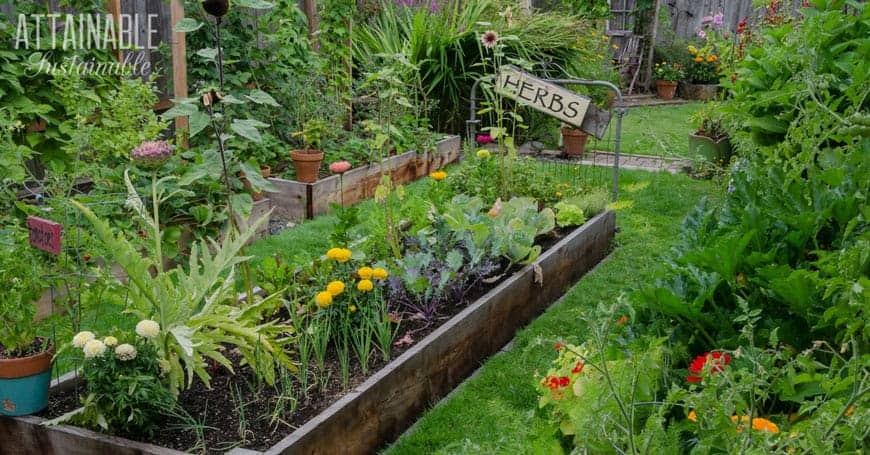
In some municipalities, governments are going head to head with residents who want to ditch their lawn in favor of an edible front yard garden. Vegetables, though, don’t seem to have what it takes for some communities. If only those homeowners associations could accept just how beautiful a vegetable garden can be!
But you know, while the cultural norm is to maintain a lush green lawn, and that lawn might be good for kids to play on, it’s not a very green option.
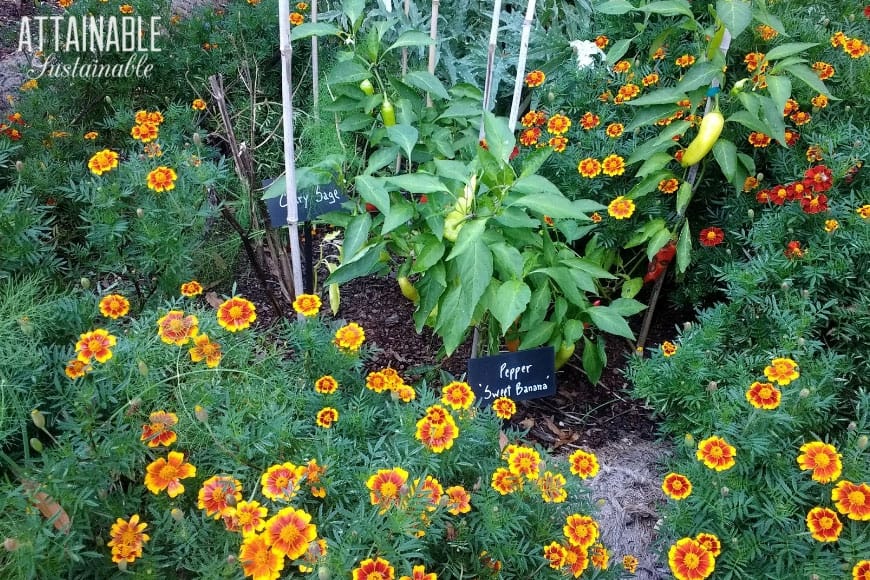
Why waste water on non-edible lawns?
Maintaining a lawn in dry, arid regions requires regular watering to keep it green and lush. Really the only way to irrigate a lawn is with overhead sprinkler systems that generate a fair amount of water waste via over spray and wind. But even if 100% of the water intended for the lawn actually benefited the lawn, does it make sense to use precious water to grow lush grass that provides essentially no value?
I understand that this is the norm – and mind you, I’ve lived in houses with grassy front lawns – but knowing what we know now, isn’t it time to reconsider whether this is a smart use of our water? An edible front yard garden can be watered with a drip irrigation system or by hand, putting the water right where it needs to go, eliminating water waste. There are even tactics for making it drought tolerant!
Poisons
Because a lush green lawn is a sort of status symbol in many American neighborhoods (what is up with that?), people will go to great lengths to keep their grass glowing. Nurseries sell products that promise nutrition, boosting, and building. That sure sounds good, but what they don’t say is that many (if not most) of these products boost and build with chemical fertilizers.
Products like “weed and feed” take it a step further as they build up the grass and kill the broadleaf weeds in the lawn. Double the chemicals, double the fun?
Grow Some Greens!
Ready to grow fresh greens, no matter WHERE you live? Sign up for my
FREE quick-start guide and start growing some of your own food!
People, these are poisons, plain and simple.
If you’re growing a lawn in order for your kids to have a play space, please consider that those bare little feet are coming in direct contact with anything you put on the lawn. (If you must have a lawn, either for the kids’ use or due to residential requirements, please, please consider skipping the poisons!)
Of course, people can and do grow vegetable gardens with chemical fertilizers, too. But since the end product will end up in our bodies, I think people are a little more wary of dousing edible plants with poisons.

Emissions
If you succeed in growing a lush lawn, the next step is to chop it off. Silly, yes? Every time the grass grows a few inches, homeowners fire up the gas mower, chop off all of that lush growth, and emit noxious fumes that contribute to global climate change. A front yard garden full of productive vegetables does not need to be mowed.
A GMO lawn?
Because it’s not hard enough already to eliminate genetically engineered crops from our lives, a “Roundup ready” bluegrass seed has recently been exempted from federal regulation. So guess what? If you’re installing a new lawn from seed or sod and it has bluegrass in the mix, there’s potential for genetically modified grass in your lawn.
Because grass seed is typically sold as a blend with bluegrass as part of the mix, it will be very hard for consumers to avoid this genetically engineered plant. The only way to be sure that you’re getting GMO-free grass is to buy organic seed or sod, something that’s certainly not common in retail outlets at this stage of the game. Organic vegetable seeds for your front yard garden, on the other hand, are readily available, so consumers can be assured that their plants are not genetically engineered.
An edible front yard garden makes a better use of your time
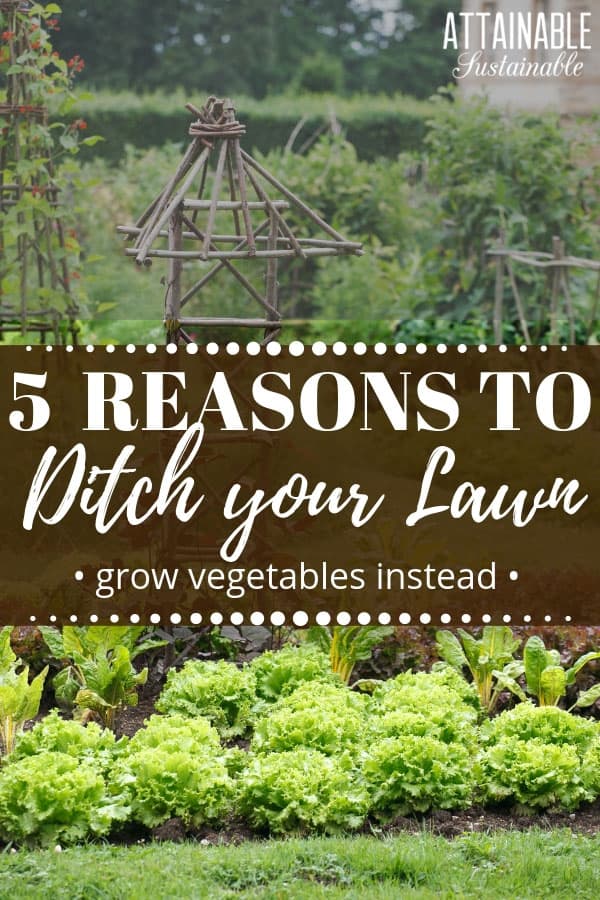
These days, it seems like everyone has a tight budget and a tight schedule. Why spend time and money maintaining a lawn when with the same effort, you could be generating food for your table with a front yard garden? Even if you only have a small space for your front yard garden, you can make it productive!
Originally published July, 2011; Updated December 2019.


I am looking to replace driveway with a semi permeable one, allowing water to get to the aquifer.
Seeking good arguments for same as we live in an HOA.
Less runoff. Less impact on local drainage. Cooler than concrete/asphalt. Off the top of my head. 😉
I like the idea – but you would think a website trying to convince people to grow veggies instead of grass in the front yard would have included pictures to show what the idea might look like. I grow veggies, enough to feed my family for half the year, and I can’t see the mess that a garden like that could actually appeal to someone as a front yard.
I am disappointed in this article. I had hoped for something enthusiastic and encouraging but instead find it critical and judgmental. It makes me want to defend grass: my sons can play football on it, it is actually MUCH easier to maintain than the garden, I do NOT use chemicals on it, nor GMO seed, we have emissions fro the rototiller every year, it provides a cooling effect and a good firebreak, I seriously do not need 1/2 acre of vegetable garden… I could go on and on. Yes, IF you are able it can be a wonderful thing to put in a garden instead of grass, but please do not judge and condemn people who still have some grass in their yard.
I think this article is merely pointing out the unsustainable nature of the typical lawn and presenting an alternative . I read it as a ‘think outside the box’ article, rather than a finger wag. You can grow food, but you can also xeriscape, plant a permaculture garden, or a lawn alternative that is drought tolerant and saves water. We are very slowly reducing our front and back lawns with native plants to create a habitat garden. I find my own child bored rather quickly by expanses of lawn, but intrigued by flowers, grasses, shrubs and trees; the myriad of insect and bird life we now attract; mud; edible plants, pathways and more! That said, we also maintain some lawn for running and playing in the backyard, which I planted with dutch clover to increase the health. If your sons are big football fans, you enjoy your lawn, and you aren’t dousing it in chemicals and drinking water, I don’t think you need to feel judged or condemned by this article. Lawns do have a place too.
P.S. I think Douglas Tallamy does an amazing job of discussing this topic in his books, if you are interested.
Bought a house last summer and had so many people comment on the thick lush appearance of the huge lawn…..yes it was pretty and not a weed in sight! Well we began to dig it up almost right away, planted our own little orchard, 4 apple trees, 3 pear, 2 elderberry, 2 blueberry and a mulberry….more to come..
Well lo and behold this spring our yeard is FULL of dandelions. Neighbor wants to know what we will do with them. Afraid to make salads with them because we believe they must have really spread poison on it last summer to make it so weed free. So for now, have grandson picking the flower heads off of them at a penny a piece to keep them from seeding in his yard! Our garden this year is 21’by 26′. We hope to increase it next year.
You can thank the French for the Lawn=Status thing, interestingly this show of abundance (they had so much they could waste viable crop land to grow a lawn) became popularized shortly before the French revolution, which was sparked at least partially due to widespread famine.
Thankfully I live in the country and the only deterant to doing as I please with my yard is defending it from the livestock and wildlife that break in. (all of my shrubs have been trimmed to trees with everything horse height and below grazed off).
Unbelievable. I got sick of my lawn and put down cardboard etc and grew potatoes. It is my experience that people love to stop and chat and ask questions. Then again, I don’t live up the wealthy end of the street where all the manicured laws are…just among some of them and I think the neighbours consider me a lost cause/blight on the landscape anyway but there are no laws regarding that here in Oz where I live.
Way to march to your own drummer! We just ripped out the front and back lawn. Adding pavers and will put back some native grass for lawn and the rest native plants front and back.
The really crazy thing about this whole thing is that it is LEGAL in all cities to apply herbicides and other harmful chemicals to your lawn, effecting not only your own health, but that of your neighbor’s, while polluting the water supply from run off, but it’s not OK to plant a veggie garden? There is something very wonky with our society.
Crazy, isn’t it?
Years ago, we dug up part of our front lawn (because it was the sunniest part of our yard) and tried to grow veggies. We had too many animal problems (especially groundhogs) but we still have a variety of herbs, including mint, oregano, and chives, in addition to various perennial and annual flowers. So far no one has ever complained – in fact we’ve gotten compliments from people walking by.
Well, I think the best way to figure out what grows well in a certain plot is to try a little of this, a little of that. Sounds like you found some winners!
I wish I were a better gardener so I could turn at least part of my yard into a garden! But I have managed to grow mint and chives without ever planting them. An edible lawn–sounds like a cool idea.
What does this mean, “a better gardener”? Gardening is nothing but experimentation – and I know you do that in your kitchen! Why not outside?
All good points, and one more: You’ll always have something to cook for dinner.
Love cooking out of the garden!
These HOA regulations and city/town codes that require such wasteful things (like grass in the yard) drive me batty. Sure … no one wants a weedy patch in their neighborhood, but I think food gardens are pretty too.
Here we do have one very small patch of “lawn,” but the rest of our property is just natural vegetation that lives on what water it gets from the sky.
We don’t have much top soil anyway, here in the Rockies, so I grow my veggies in my little greenhouse and (based on your idea) in bales of straw (it isn’t going great, though).
Lawn is nice for kids and dogs. I’m going to write a post about straw bale gardening. It’s not going so well here, either.
I love the idea of having vegetables growing in front of the house! Recently I had to reseed part of our back lawn. I did it with regret, because I dislike grass so much. If you have a lawn the way I do, because my mom had a lawn in DC and wanted one when she moved to Cape Cod 40 years ago, you must learn how to take care of it without chemicals. Paul Tukey writes a great blog about avoiding lawn chemicals, Safe Lawns. He is the one who made the film A Chemical Reaction about the town of Hudson, Canada, which decided to ban herbicides.
I’ll have to look for that film.
The idea that people are FORCED to have pointless grass in the front yard makes me see red. It is absolutely bonkers.
Bonkers it is.
I grew lettuce in my front yard, almost by accident, and it’s been lush enough to feed the family. Plus it’s discreet so no one knows it’s there unless they’re actually in my yard. I’d like to replace my lawn with herbs, maybe. I just hate lawnmowers. I tell everyone I love my little manual push mower, but really it’s kind of a pain.
Great blog, by the way. I found it through someone else’s blog awhile ago. I love your ideas.
Thanks, glad you found me! We have a push mower, too. You have to be really diligent; once the grass (ahem, weeds) get too tall, it’s hard to cut! One herb that would be a great lawn replacement is creeping thyme. It stays low and is really hardy.