
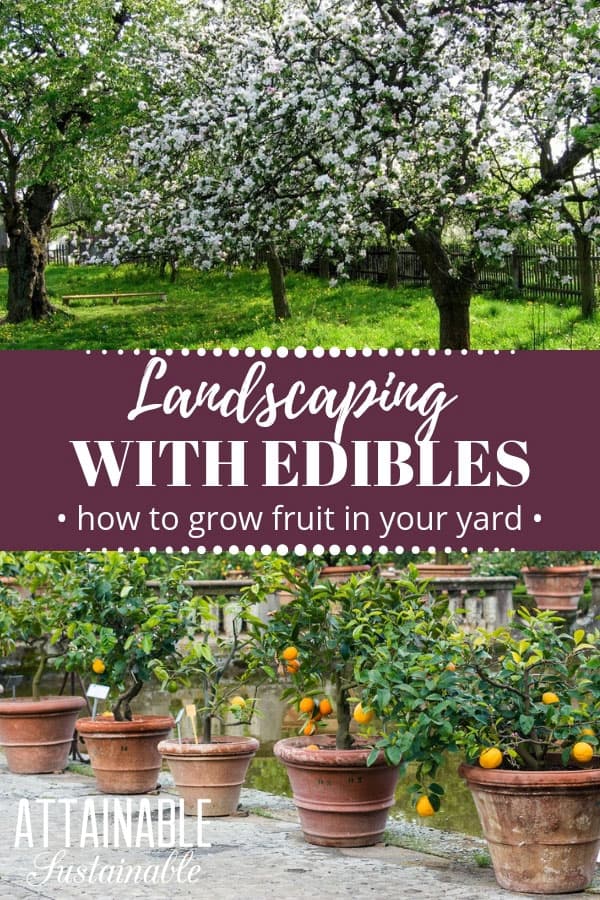
Consider planting urban fruit trees in pots or as part of your front yard landscape for an edible garden. Landscaping with fruit trees allows you to harvest food from even a small space garden.
If you’re trying to get the most out of your grow space, consider these vegetable crops that are pretty enough for the front yard!
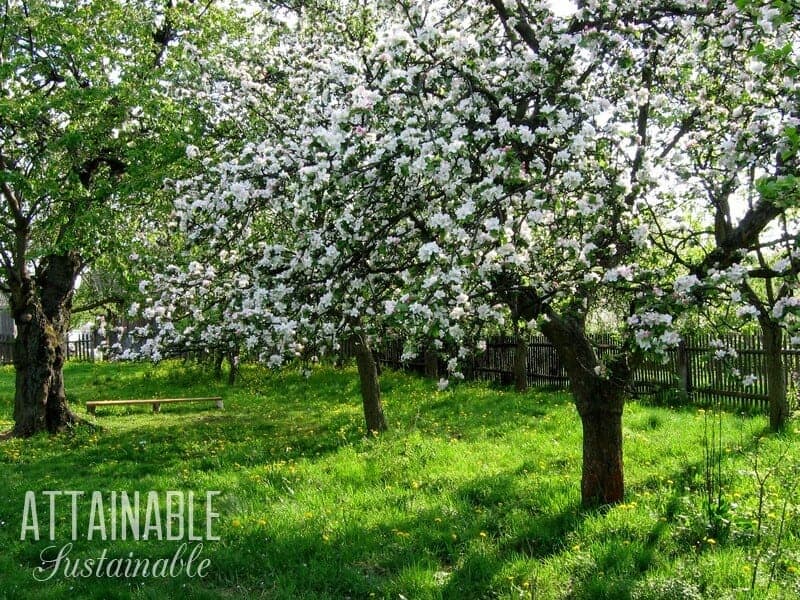
An edible landscape is essentially an aesthetically pleasing design that incorporates productive crops. Growing fruit trees as dual-purpose landscape plants is a great way to make the most of the space you have. Pretty blossoms in the springtime, fruit in the summertime, and a tree to create shade or structure within your garden!
Why some people don’t plant fruiting trees
Fruit trees are no different than many non-fruiting landscape trees, with one exception: They provide a harvest. To me, that sounds fabulous. If a tree is taking up space in my yard, better that it offers up some fruit. But not everyone wants to deal with harvesting fruit. (It’s likely that those people are not here reading this, though!)
In designing public spaces, there’s a hesitancy to use fruiting trees because of the mess factor. If a tree fruits and nobody is there to harvest that fruit, it will fall to the ground.
Fruit on the ground is unsightly and can draw undesirable insects and rodents, or become a tripping hazard. These are valid concerns for commercial and community spaces, though it does seem like a missed opportunity.
Grow Some Greens!
Ready to grow fresh greens, no matter WHERE you live? Sign up for my
FREE quick-start guide and start growing some of your own food!
Why not plant productive trees, creating an edible landscape with the intention to harvest the fruit for local food banks? That seems like a great use of common areas and medians.
 Related: Small Vegetable Garden Ideas: What to Grow to Make the Most of Your Space
 The 5-Gallon Garden
New to gardening? Limited on space? The 5-Gallon Garden gives you the skills you need to grow food in the space you have. Get started with your garden today!
List of fruit trees for an edible landscape
Apple – The spreading branches of a mature standard-sized apple tree are perfect for sitting under. Beautiful white and pink blossoms in the spring are slightly fragrant. Harvest, late summer and autumn. [Read more about growing apple trees here.]
Banana – Ranging in size from a few feet tall to more than 20′ tall, there is a wide selection of banana varieties available to backyard growers. Choose small banana plants (see here for some options) for container growing.
Bananas require a warm climate, but some intrepid growers plant them in large containers and move them into a protected area during cold winter months.
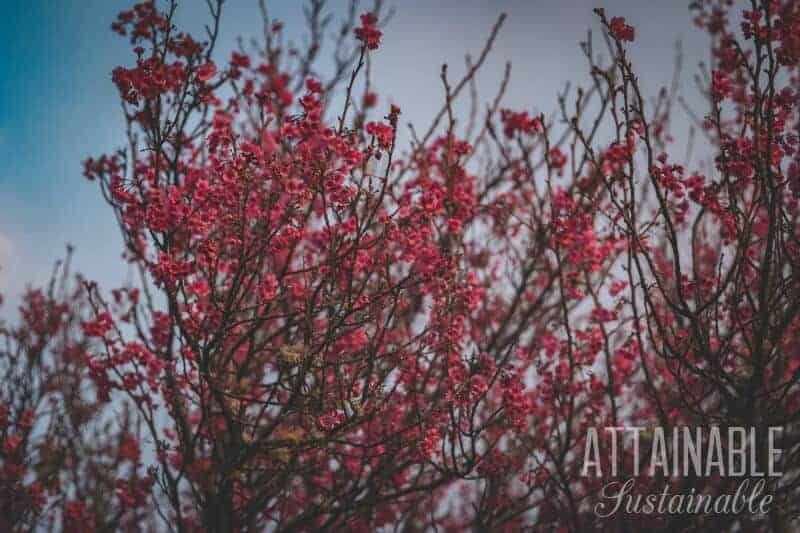
Cherry – Non-fruiting or “ornamental” cherry trees are frequently planted for their gorgeous blossoms. Opt for a fruiting variety for more bang for your buck. Harvest, early summer
Citrus – An evergreen tree for frost-free climates, citrus trees like orange, tangerine, and lemon are year-round beauties. Harvest, winter.
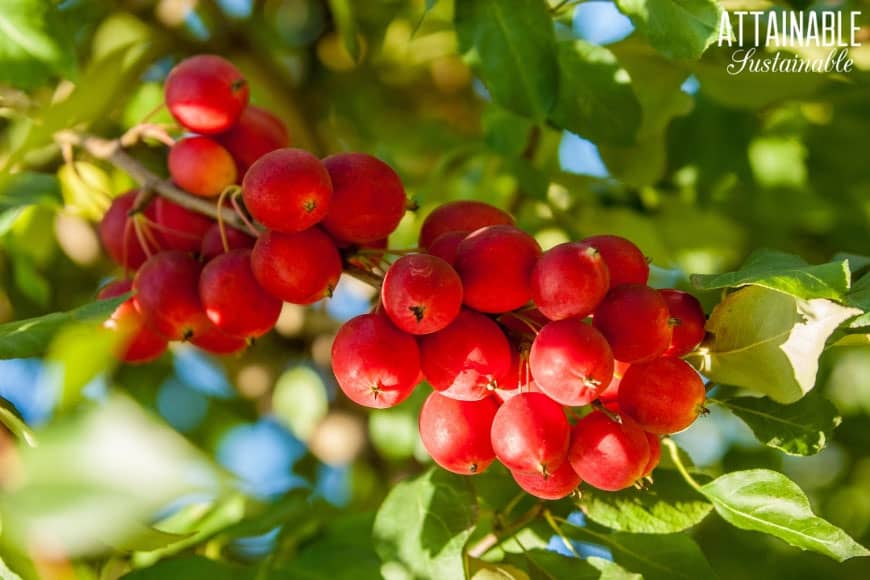
Crabapple – Less commonly known than standard apples, crabapples are edible and there are some pretty compelling reasons to plant one. You can read more about planting and growing this fruit tree here.
Fig – The oversized leaves of a fig tree offer a tropical look to the landscape. Many fig varieties offer two harvests per year. Figs are easy to grow in pots, too.
Mulberry – With large fruit resembling blackberries, a mulberry tree can serve several purposes in your edible landscape. The fruit is excellent, if a bit hard to harvest. It can also act as a lure to draw birds and squirrels away from other ripening fruit. Try planting one in an area where the dropping fruit can provide fodder for chickens so that any fruit you don’t harvest will go to feed your flock.
Nectarine – The dark, slender green leaves of a nectarine tree make it a summertime beauty. Harvest, late summer. Here’s how to start a nectarine tree from seed.
Olive – An evergreen tree with fine leaves, olive trees are great landscape plants and people often plant them for their beauty rather than the fruit. Olives need to be processed before they are edible.
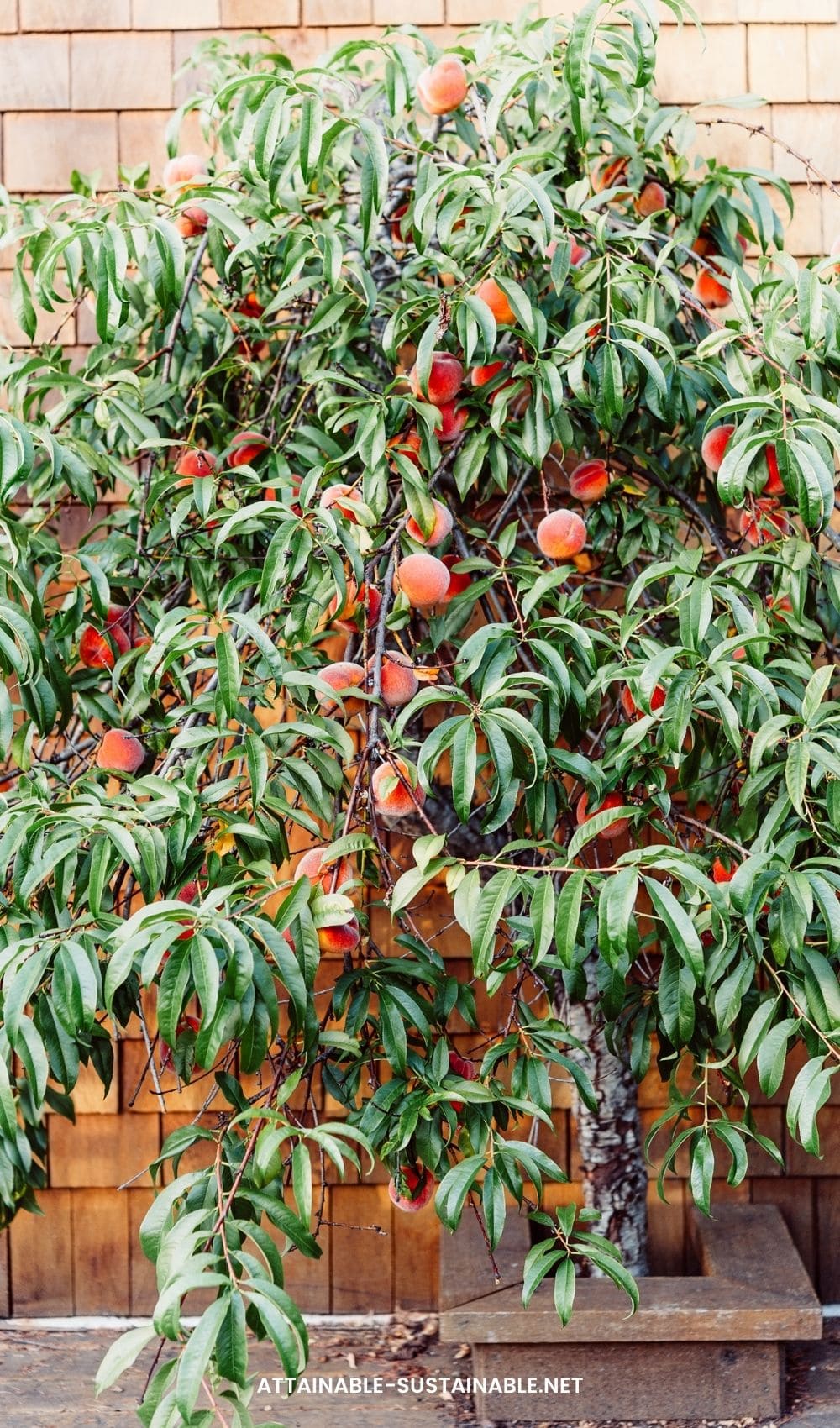
Peach – The fuzzy fruit of this summer-bearing tree is delicious fresh out of hand, but if you have plenty, consider preserving some for the pantry. The trees grow similarly to a nectarine and offer pretty pink springtime blossoms.
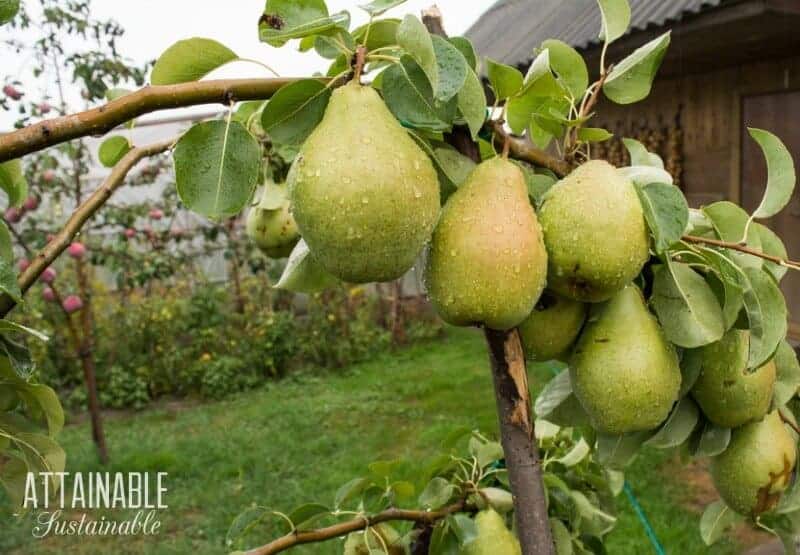
Pear – In addition to delicate spring blossoms and a tasty crop, pear trees offer fall color to your yard as well. Harvest, late summer.
The 5-Gallon Garden
New to gardening? Limited on space? The 5-Gallon Garden gives you the skills you need to grow food in the space you have. Get started with your garden today!
Persimmon – A beautiful tree with spreading branches, persimmons are most noticeable in the fall when the leaves drop and bright orange fruit remains. Harvest, autumn. Here’s more on growing a persimmon tree.
Pineapple guava – A small tree or upright shrub, this evergreen produces bluish green fruit. It grows we ll in cool coastal locations. Harvest, summer.
Plum – Desirable for their vivid pink spring blossoms, flowering plum trees are used frequently as a landscape plant. You can have similar beauty plus a great harvest by choosing a fruiting plum. Harvest, late spring and summer.
Related: 15 Smart Gardening Hacks to Save You Time and Money
Size matters
Fruit trees come in four different sizes: Standard, semi-dwarf, dwarf, and less commonly, super-dwarf. This means that you can choose a tree that will fit your space perfectly. When considering the options on the list of fruit trees above, decide which size tree will work best for your space. For urban areas, small fruit trees are probably the most sensible.
- Standard fruit trees need a fair amount of space and are a good choice if you’re hoping for high branches that will provide shade.
- Semi-dwarf trees are great for incorporating into a garden bed as a visually upright specimen.
- Dwarf varieties are great if you’re an urban gardener. Plant them directly in the ground or in pots.
- Super dwarf trees are great for really tight spaces like apartment balconies. There are not as many choices available in this miniature size, unfortunately.
Choosing a dwarf tree variety will not impact the size of the fruit. A dwarf tree doesn’t mean a smaller apple; it just means that the size of the tree itself (and thus the quantity of fruit) will be reduced, making it a perfect urban fruit tree option. They’re ideal when growing fruit trees in pots. This is done by grafting various fruit varieties onto a rootstock that produces small trees.
Growing fruit trees in pots
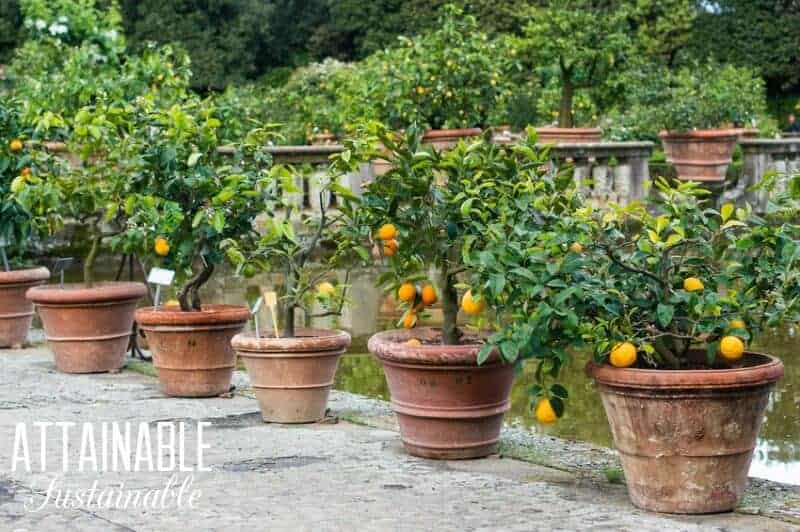
If you want to add a tree to a patio area or need to be able to move certain warm weather varieties inside for the winter, growing fruit trees in pots might be the solution. Dwarf and super-dwarf varieties are the best option for growing in containers. The trees stay small and compact.
Choose your container
A 10-15 gallon container will work for most dwarf varieties and is a good size if you need to move your tree. A half oak barrel will give the roots a bit more space to spread out, but can be heavy to move. Be sure your container has a hole or two in the bottom so excess water can drain. Grow bags (the largest size) would be another good option.
Soil and fertilizer
Choose a good quality potting soil. Your potted urban fruit tree will be growing in a confined space; make sure it’s as healthy as possible. Fertilize your tree every couple of weeks during the growing season with compost or manure tea. I like to spray fruit trees with liquid kelp every few weeks, too. See more about planting bare root fruit trees here.
Adding fruit trees to an edible landscape
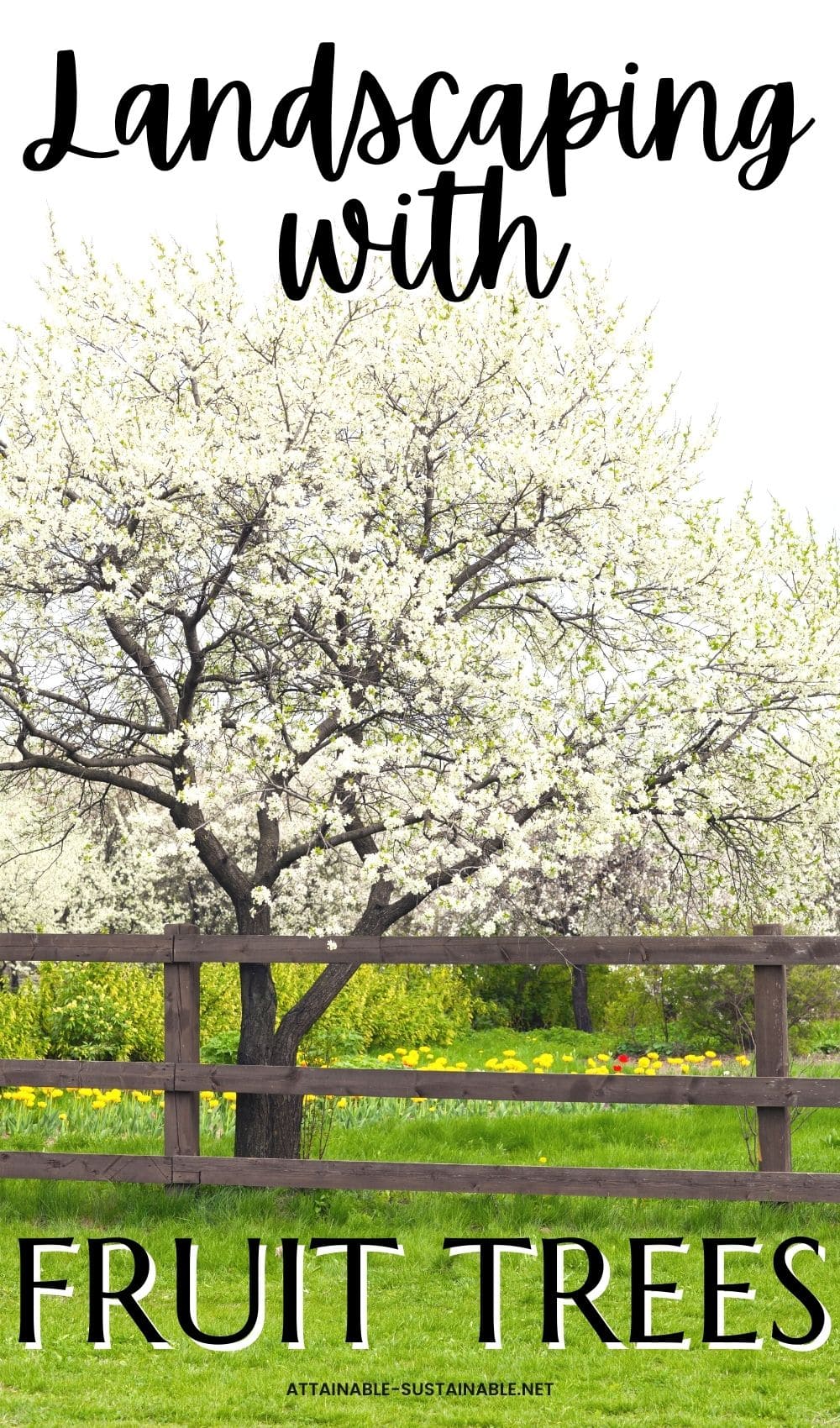
Adding a fruit tree or two to your yard or garden is pretty easy, but there are a couple of things you should think about before diving in and landscaping with fruit trees.
Chill hours
Basically, urban fruit trees need cold weather to triggering flowering (and thus fruiting). Some varieties need more than others. In my not-so-chilly region, I have to seek out fruit trees that are “low chill” varieties. You’ll need to determine how many chill hours (the average number of hours below 45 degrees Fahrenheit) you get each winter.
Pollination
In order for fruit to set and grow to maturity, the blossom needs to be pollinated. This is why it’s so important to encourage bees and other pollinators in your garden by planting flowers or creating a hospitable environment. This goes for garden crops as well as fruit trees. Bees carry pollen from one bloom to another, helping to pollinate each.
Fruit trees are sometimes self-fertile, meaning that pollination can happen with just a single tree. This is most common with stone fruit like peaches, nectarines, and apricots. Others require cross-pollination between two trees. Choose two trees within in the same species that bloom at the same time and plant them within 50 feet of each other.
Placement
Be sure to situate your small fruit trees in an area that won’t be negatively impacted by dropping fruit. Likewise, be sure that you take maintenance into consideration when landscaping with fruit trees. You’ll need access to prune and harvest your crop!
Seasonality
One other thing to consider is what fruit is in season when. If you plant ten fruit trees that all produce fruit during the summer months, the rest of the year will be pretty lean as far as fresh fruit. Instead, think about planting a variety that will ripe across the seasons. Read more about seasonal fruits for some inspiration when choosing urban fruit trees for your yard.
Originally published in February 2017; this post has been updated.


Hi Kris. After reading some of your tips, I planted a few fig trees here in Pennsylvania. This past summer they grew to about 9’-10’ And had tons of amazing figs. I’d say just be patient. The first year or two they grew beautiful leaves but no fruit. Then bam! Tons of figs. I do wrap them to protect against frost every winter. So I’d say try it to anyone, fresh figs are so worth it. Thanks again for sharing all of your knowledge. Mimi
I like your ideas but clearly you don’t live in the South! With the exception of figs and blueberries, every other fruit has to be sprayed endlessly! Between the fungus /disease problems and the boring insects, it’s a constant cycle of spraying! Just don’t want to have to spray that much.
This list is meant to be a springboard of ideas. It sounds like you’ve found 2 that will work for you!
The key to a disease resistant fruit tree is to feed the earthworms in the soil around the fruit roots often. I don’t ever need to spray my fruit trees or roses. Instead, I take all of my food scraps and run them through my blender to make a smoothie that earthworms will consume quickly AND poop out quickly making the soil nutrient dense and black. The fruit tree will became stronger and healthier.. Feed the earthworms around the roots of the fruit trees often and mulch really well…you’ll be glad you did!
This is definitely worth a try, healthy worms and soil are always a good thing! 🙂
Meyer lemons can be easily grown in a pot. All trees can be kept pruned smaller, but it’s easier to just have those that are grafted on dwarf root stock. For people like me who live in a clay ground area (I’m in southern California), I would dig down and amend the soil. The old adage of dig a $10 hole for a $5 plant works wonders. To Annette L. in Southern Cali, if you are going to plant in a box without a bottom, I would agree with Kris except I would dig down at least a foot and amend the clay with 1/3 compost and some gypsum. This way the roots go from great soil to decent/ok soil to the clay. Don’t forget, that raised area should probably be at least 6′ across because of root growth. I don’t know for sure, but I’ve heard that fruit trees have a small crop every 3rd year and if that’s true, I just experienced it. The people before me never pruned and big branches cracked off the peach tree. I’ve seriously pruned down the peach, plum and apricot trees. Planted an almond and banana apple tree. I will be pruning slightly the cherry and pomegranate trees. All of those are in ground. In pots I have: Meyer lemon, Valencia orange, Pomelo, red dragon fruit (not yet fruiting), red plumeria and fiddle leaf fig (non-fruiting). The ones in pots need protection during the cold months where the nights are below 40 degrees.
Thank you for your article. I enjoyed reading it very much.
I live in Arizona. I have many citrus, and a couple struggling apple and orange trees. Tired peach and nectarine, both died. Do you think edible cherries and in a container or in the ground?
I’d contact your local cooperative extension office for the best regional advice.
Can you grow a Meyer lemon in a pot I want to grow a dwarf size
Yes, but for a dwarf tree you’d need to get a tree that was grafted onto dwarf root stock.
can i grow this fruit in pot in tropical weather
It really depends. Many fruit trees require a certain number of chill hours that they just won’t get in the tropics.
My pear trees in Seattle had fireblight. I was told it was carried by bees drawn by spring blossoms, and that the treatment was to spray the trees while they were in blossom with streptomycin. I did that, and hygenically cut away the affected stems from the trees. It worked. I wondered if if the streptomycin in the nectar and pollen might help the bees with foulbrood, which I read was a factor in declining bee populations. What do you think?
I’m not a beekeeper, so I don’t really know.
The soil in my Southern California yard is clay. I would like to plant some semi dwarf fruit trees in raised square boxes (bottoms removed) filled with good potting soil and set directly on the ground. The goal is that the trees will get a good start in the potting soil and eventually the roots will grow down into the soil beneath the boxes. Good idea or not?
Hard to say if it’s a GOOD idea, but it’s one I’d try. Here’s what I’d add:
1. Scarify (kind of roughen up) the soil below the pot. If the roots hit a flat layer of clay, they can just think they’ve hit the bottom of the pot and become pot-bound. If there’s a more uneven surface, they tend “push” into the soil.
2. Put a 6″ layer of manure in the pot before you add potting soil. . I’ve seen piles of manure do amazing things for breaking up soil.