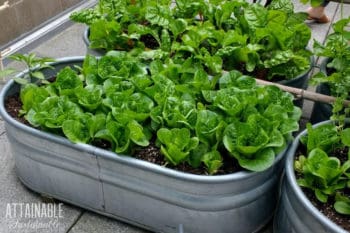
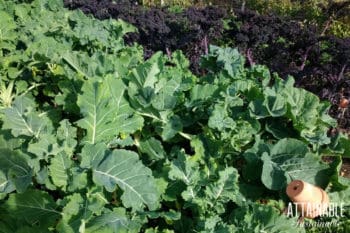
Even apartment dwellers can grow a pot of chard and the beauty of a pot of chard is that it will provide food for months.

One of the plants that’s thriving in my oh-so-wet-and-rainy garden this year is stevia. It’s the first time I’ve grown it, so I’m pleased to see it do so well, but how to use it? For starters, just chewing on a fresh leaf gives a burst of sweetness that’s welcome when you’re trying to cut back on processed sugars. I’ve tried tossing a few fresh leaves in with hot tea, but don’t notice much in the way of sweetening with this method. I really wanted to have a go-to sweetener at the ready for tea and coffee, so I decided to try drying it, which was super simple to do. I stripped the leaves from the stems, cleaned them in a bowl of water, and took them for a spin in the salad spinner.
Unless you’re growing head lettuce, your greens can be a “cut and come again” crop. Instead of pulling the entire plant, thus ending the fresh salads, use scissors to cut off the outer leaves near the base of the plant. Leave the inner leaves intact and the entire plant will continue to grow. I’ve been harvesting my lettuce this way for a month and will continue to do so until the plant goes to seed. This is what my lettuce looked like before today’s harvest: This is what it looks like now: Within a week, it will look like that first picture again.
I posted earlier about my upside-down tomato experiment. After several months of growing, this is what it looks like: And here’s another plant, complete with ripening fruit: There is some slight browning on the edges of some of the leaves that I’m keeping my eyes on. I’m watering only about once a week, which surprises me. I’d expected this plant to dry out quickly, but so far that hasn’t been the case. I’m pleased enough with how it’s growing that I intend to plant a few more this way. Want to try it yourself? Instructions here.
(If you’re reading this on the front page, click through for more images.) I’ve been gardening for years, but the idea of planting in straw bales is new to me. I ran across this post about straw bale gardening earlier this year and was intrigued enough to mention in on the Attainable Sustainable Facebook page. It seemed like a perfect way to add a garden to a space that was less than ideal for growing. My own garden space is severely sloped and we were in the process of terracing it with rock walls to create more usable space when my husband’s job took him off the island for an extended period. Without my rock guy, I was stuck – until I remembered those straw bales. I did a little reading and learned that straw bales could last a couple of years in the garden. If they lasted that long, why couldn’t I use them to retain my garden? I’d have the level planting space I needed, plus I could grow more vegetables right in the “wall.” I enlisted my teenagers to help me move the bales into place (they’re awkward and a bit heavy). The good news: the...
Basil is one of those wonderful garden plants that just keeps coming. Unlike radishes and beets that are done once you harvest them, basil plants provide their pungent goodness for months if you can stay on top of them. Basil should be harvested regularly to prevent flowering. To do so, simply use scissors to trim off the upper leaf clusters, making your cut close to the set of leaves below. New growth will sprout from this point so you can continue to harvest throughout the season. Here’s a basil plant ready for harvesting (click on the post title to see all images if you’re reading this on the front page). The flower buds are just starting to form. This is what a plant looks like after the harvest. You want to make sure to leave some green growth so that the plant can do its photosynthesis thing, but the plant will be noticeably smaller. Healthy basil plants will need to be harvested every week or so. I have almost a dozen plants and these provide enough basil every time I harvest to make two batches of pesto – one to eat fresh, one for the freezer.
If you’ve not yet planted your tomato plants out into the garden, let me share a little tip with you. With most other plants, you want to set the plant in the earth so that the soil level of the potted plant is at the same level as your garden soil. Tomato plants, however, like to be planted deeper than that. Go ahead and dig a hole deep enough to allow the main stem to be buried up to the first set of leaves. My tomatoes have all been planted out, but through the miracle of technology and with the aid of my son, I have a little graphic example for you. See that brown line? (Click through for a larger image.) That’s where the soil level should be when you plant the tomato. The tomato will send out little roots from that stem, making the plant much more stable in the ground and giving it more opportunities to pull up nutrients. If you have a really leggy tomato plant, you can even lay the plant in a horizontal hole, covering most of the stem but allowing the top of the plant to emerge above the level of the...
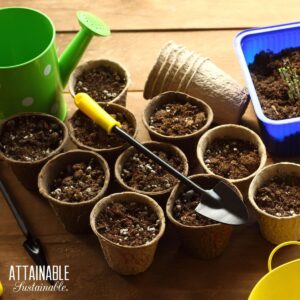
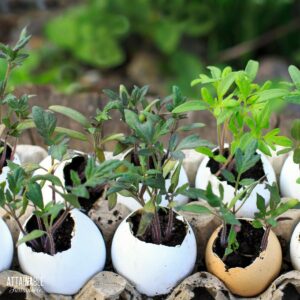
As someone who’s been growing a garden – or at least helping to grow a garden – since I was a child, it is almost unfathomable to me that someone could not know how to plant a seed. I’ve had several people ask me about seed starting recently, though, so I have to assume that there are more people out there who have yet to acquire this knowledge. Good news: It’s simple! To get a head start on the growing season, plan to start your seeds 4-6 weeks before you’ll be ready to set them out in the garden. This will be determined by your region’s last frost date. You don’t want to plant your garden too early, only to have Jack Frost kill all of your little plants. You will need: A container: You can reuse nursery containers if you have them, or alternatively, use plastic containers scrounged from the recycle bin* Potting soil (available at nurseries or hardware stores) Seeds Fill your containers with potting soil to within 1″ of the top. Seed packets include planting directions and will note the planting depth for each type of seed. Generally speaking, if you’re planting a large seed (beans,...