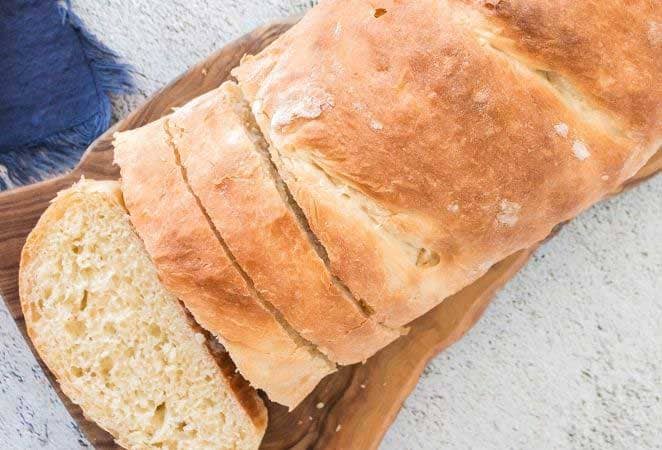
Easy French Bread Recipe
Making homemade bread from scratch can sound daunting, but it's mostly a hands-off process and the end result is SO worth it.
Print
Pin
Servings: 12 servings
Ingredients
- 2.5 teaspoons active dry yeast
- 2 tablespoons granulated organic cane sugar
- 1 ¼ cups warm water divided, (around 100 degrees F)
- 2 ½ cups bread flour
- 2 teaspoons sea salt
Instructions
- Combine 1/4 cup of the warm water with the dried yeast and sugar in a medium-sized mixing bowl. Allow to sit and "proof" for 5-10 minutes or until you see bubbles and signs of life in the yeast.2.5 teaspoons active dry yeast, 1 1/4 cups warm water, 2 tablespoons granulated organic cane sugar
- Add the water, flour, and salt and mix until a rough dough forms. Wet your hands slightly and knead the dough for just 2-3 minutes or until a cohesive but still rustic feeling dough forms. Cover and allow the dough to rest for 30 minutes.2 1/2 cups bread flour, 2 teaspoons sea salt
- Return to the dough and perform a stretch-and-fold by folding each side of the dough onto the mass of dough. Looking down at the dough, imagine it as the face of a clock. Start at the 12 and stretch and pull that corner onto the mass of dough. Repeat with the 3, 6, and 9 edges respectively.
- Cover and allow to rise an additional 45 minutes and repeat stretch-and-folds. Cover and allow to rise 30-45 minutes, or until doubled in bulk.
Forming the loaf
- Lightly flour a sheet of parchment or a clean work surface. Place the dough on the floured surface and stretch the dough into a rectangular loaf shape as you would a sandwich loaf. Stretch the long ends of the loaf and tuck them under the rectangular loaf. Allow to rest for 3-5 minutes. Return to the loaf and stretch it out to a loaf 12-18" long by rolling it back and forth and elongating the dough. Either transfer the parchment to a baking sheet or transfer the dough to a greased baking sheet that has been lightly dusted with flour.
Second rise
- Once the loaf is formed correctly, cover with a damp towel or plastic wrap and allow to rise for 60-90 minutes or until nearly doubled in bulk. Preheat the oven to 400 degrees when the loaf has risen by 50%.
- Remove the towel or plastic wrap and, using a very sharp knife or razor, slash the dough diagonally in three to four places. Place bread in hot oven and bake 30-40 minutes or until browned nicely on the outside and baked through. You can test the loaf by turning it over and thumping the bottom. If it sounds hollow, it is done.
- Move to a cooling rack; allow to cool for at least 20 minutes before slicing.
Notes
- This recipe makes a single loaf of French bread. To make multiple loaves, measure yeast for each loaf into a small bowl and begin the proofing process by adding warm water. Then measure flour for one loaf of bread into the mixer bowl along with the proofed yeast and remaining ingredients. Knead, then transfer the dough to an oiled bowl. Put the next batch of ingredients right into the mixer bowl (there’s no need to wash that between loaves). Allow the dough to rise and bake multiple loaves at once.
- If you do not wish to knead this recipe by hand, you can let the stand mixer do the work. In a mixer equipped with a dough hook, all ingredients are combined, process on low until dough comes together to form a ball and pull away from the side of the bowl. It should feel tacky, but not stick to your fingers.
- This recipe will work with all-purpose flour, though the end result may have *slightly less chew.
Nutrition
Serving: 1slice | Calories: 104kcal | Carbohydrates: 21g | Protein: 3g | Fat: 0.5g | Saturated Fat: 0.1g | Polyunsaturated Fat: 0.2g | Monounsaturated Fat: 0.1g | Sodium: 390mg | Potassium: 32mg | Fiber: 1g | Sugar: 2g | Vitamin A: 1IU | Vitamin C: 0.002mg | Calcium: 5mg | Iron: 0.3mg
Did you make this recipe?Mention @attainablesustainable or tag #attainablesustainable!