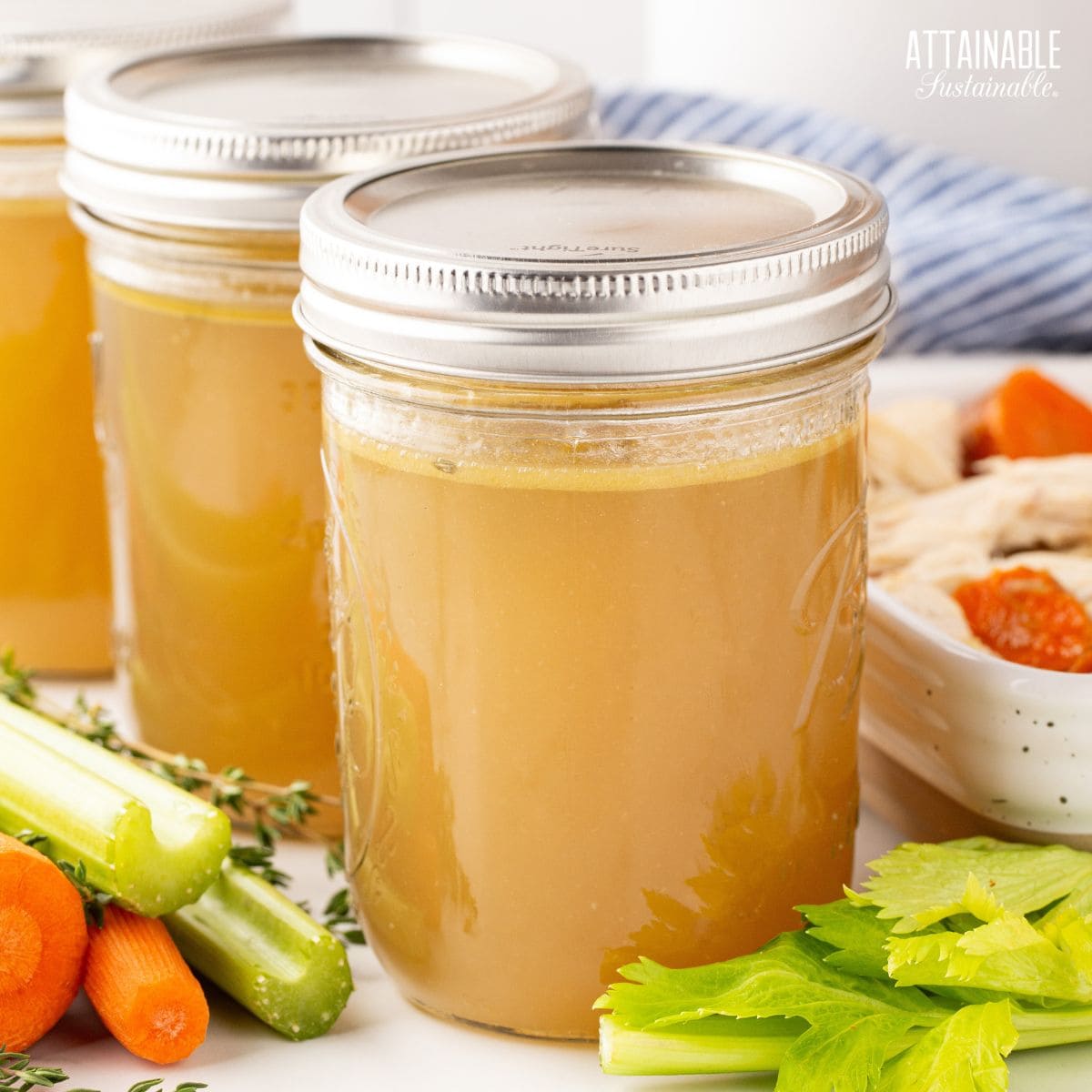
Pressure Canning Broth
Making broth at home is an easy and inexpensive endeavor. Learning to pressure can broth to create a shelf stable ingredient saves time and money!
Print
Pin
Servings: 28 servings
Equipment
- 7 quart jars
- 7 canning lids and rings
- canning funnel
- Pressure canner
- jar tongs
- canning bubble popper/measurer optional but handy
Ingredients
- Roasted bones to fill an 8-quart stockpot see notes
- 1 - 2 cups raw vegetables optional
Instructions
Recipe yields 7 quarts.
Make the Broth
- Use roasted bones leftover from cooking a whole chicken, duck, or cut of beef. (You may wish to freeze bones until you have enough to fill a large stockpot.)
- Alternatively, place raw bones on a baking sheet, drizzle with oil, and sprinkle on salt and pepper. Roast in a 425°F oven for 30 minutes or until the bones are well-browned. Discard fat and use bones to make broth as instructed below.
The stovetop version:
- Place the roasted bones in a stock pot along with the vegetables. Fill the pot with water to within 3" of the top.Roasted bones to fill an 8-quart stockpot, 1 - 2 cups raw vegetables
- Bring to a low boil, then simmer (with the lid on) for 12-48 hours.
The slow cooker version:
- If you have a slow cooker or Instant Pot, you have the freedom to let your stock cook for a day or two without having to worry about leaving a burner on for a lengthy time. Cooking for this long draws out all the goodness of those bones and makes a nice, gelatinous broth.
- Place roasted bones in the pot, cover with water, and cook on low heat for 24 to 48 hours to create a rich bone broth.
- Use tongs or a slotted spoon to remove the bones and vegetables.
Prepare for Canning
- Wash the jars you'll use in hot soapy water, making sure each is clean and free of nicks in the rim, which could impede sealing.
- Fill the pressure canner according to manufacturer’s directions. Place jars in canner, filling with enough water to prevent floating. Begin heating canner when the broth is near ready.
- Wash the lids and rings in hot soapy water. (If you're using non-Ball brand lids, prepare as suggested by manufacturer.)
Process the Jars
- Lift empty hot jars from the canner, drain, and set on a towel covered surface. Double check the water level in the canner to make sure it’s where it should be.
- Ladle broth through a strainer into the jars, leaving a 1" headspace.
- Wipe jar rims to remove any residue that may have spilled. A clean rim is essential to a good seal.
- Set jar lids in place. Screw bands on finger tight.
- Use a jar lifter to gently transfer the jars to the pressure canner.
- Lock pressure canner lid in place and turn the heat up to high.
- Watch for steam escaping from the vent pipe. When it begins to come out in a steady stream, set the timer for 10 minutes. Once vented, place the weight on the vent (15 pounds) or shut the petcock.
- For a dial-gauge pressure canner, bring it to 11 pounds of pressure, then adjust heat to maintain that pressure. For weighted gauge canners, heat until the weight begins to jiggle or rock; this indicates that the canner has reached 10 pounds of pressure inside. Adjust the heat so that it rocks steadily. Do not leave the pressure canner unattended.
- When canner reaches necessary pressure, begin timing. Check pressure frequently to maintain required pressure. If pressure drops below what is recommended in the recipe, return to pressure and start timing all over again.
- Process pint jars for 20 minutes; quart jars for 25 minutes at elevations below 1,000'. See notes for altitude adjustments.
- When processing time is complete, turn off heat and allow canner to cool completely. Dial gauge canners should register zero pressure; weighted gauge canners should be allowed to reach room temperature.
- Remove the weight (it will be hot!) or open the petcock; open lid.
- Use a jar lifter to remove the jars from the canner, placing them on a towel-covered surface. Allow to cool undisturbed for 12-24 hours.
- Check seals. Lids should be solid and pulled down tight. (If they flex and pop, the jar didn’t seal; put unsealed jars in the refrigerator and use those first).
- Remove rings and wash outsides of jars. Label and store in a cool, dry place for up to a year.
Notes
- Recipe yields 7 quarts.
- Boiling lids or heating above 180°F as once recommended can damage the sealing compound.
- Use the carcass from a roasted chicken, turkey, or even duck. For beef or pork broth, you can use bones from a roast or purchase bones from the butcher. Be sure to roast any raw bones before making the broth for the richest flavor. (I've made broth from raw beef bones...once. I'll never do that again.) One turkey carcass is enough to make a stockpot full of broth; use 2-3 chicken carcasses, or for pork and beef, use enough bones to fill the pot halfway.
- The making of the stock is easy. Place the roasted bones and optional vegetables in a large pot, slow cooker, or electric pressure cooker and cover with water. Cook over low heat for 12-48 hours. A long, slow cooking time draws out all of the flavor from those roasted bones.
Altitude adjustments for both pint and quart jars
Dial gauge canner:
- 0-2,000' - 11 pounds pressure
- 2,001-4,000' - 12 pounds pressure
- 4,001-6,000' - 13 pounds pressure
- 6,001-8,000' - 14 pounds pressure
- 0-1,000' - 10 pounds pressure
- 1,000' and up - 15 pounds pressure
Nutrition
Serving: 1cup | Calories: 38kcal | Carbohydrates: 3g | Protein: 5g | Fat: 1g | Saturated Fat: 0.4g | Polyunsaturated Fat: 0.3g | Monounsaturated Fat: 1g | Sodium: 71mg | Potassium: 203mg | Sugar: 0.3g | Calcium: 9mg | Iron: 0.5mg
Did you make this recipe?Mention @attainablesustainable or tag #attainablesustainable!