When fresh cranberries are available, it’s a great time to make up a batch of homemade spiced cranberry sauce for canning.
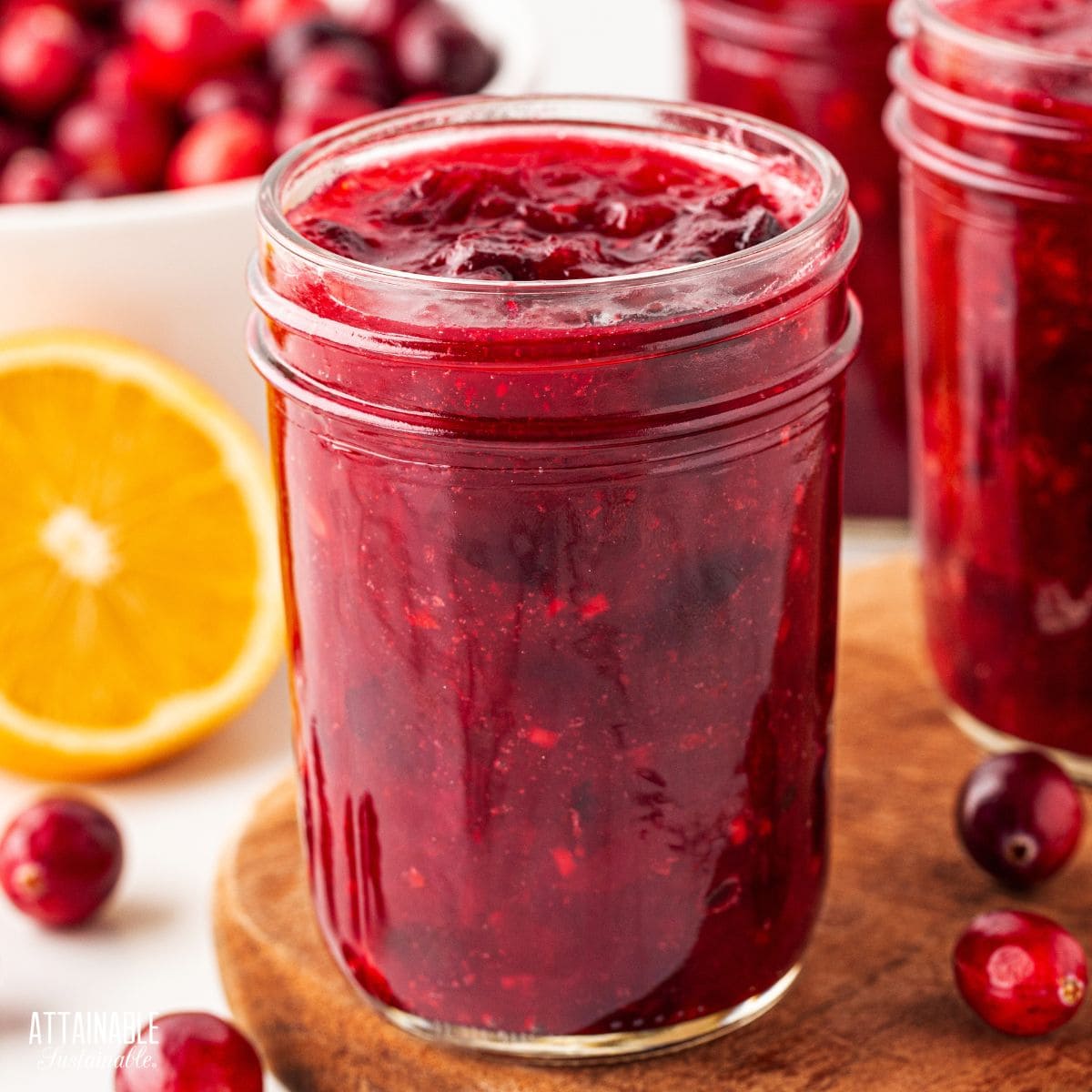

Ingredients
Cranberries — Pick up bags of whole fresh cranberries while they are in season. You can also buy extra bags of this fall fruit to freeze for later, if you’re too busy with the holidays to fuss with canning.
Sugar — Use your favorite brand of granulated cane sugar. I prefer organic. Would brown sugar or maple syrup be an okay substitute? Certainly!
Orange Juice — While we can all agree that fresh orange juice tastes best, in the busyness of the holidays OJ concentrate is just fine.
Ginger — Choose fresh knobs of ginger. Use the edge of a spoon to scrape off the thin skin.
Note that there is no need to add bottled lemon juice to this recipe, as the cranberries are acidic enough on their own.
Get a Quick Start Guide to Safe Canning!
Want to learn how to preserve the harvest? Dive in for a look at various canning techniques and methods! Grab my FREE 6-part guide to getting started.
Making the Cranberry Sauce
There’s really very little prep for this recipe, outside of mincing the ginger.
Wash the cranberries and combine with the remaining ingredients in a big stock pot and simmer.

Do you prefer a jellied cranberry sauce or a chunky one? You can adjust the texture based on how much you mash the berries. For a very smooth cranberry sauce, process it with an immersion blender to eliminate any chunky pieces.
🍅 Safety First!
Canning is an excellent way to preserve food for the pantry, but there are some important safety considerations to keep in mind. The recipes on this site have been made following safe canning procedures by a Master Food Preserver.
- Know the difference between water bath canning and pressure canning. Low acid items must be pressure canned for safety.
- Altering ingredients may change the recipe’s pH, posing a safety issue.
- Use the proper jars and lids. Never reuse lids, with the exception of the Tattler or Harvest Right hard plastic lids that are intended for such a purpose.
- For more on canning equipment, please go here.
- Want to learn more? The National Center for Home Food Preservation is the go-to resource for safe canning information.
Process the Jars
You’ll need special canning jars, lids, and rings to make this a shelf-stable product, but the process isn’t difficult.

Transfer the cranberry sauce into canning jars, leaving a half-inch headspace. Use a non-metallic knife, chopstick, or bubble remover to remove any air bubbles. Wipe the rims of the jars, removing any residue.
Place the lids on and process them in a boiling water bath canner. What this means is you’ll put the filled and sealed jars of cranberry sauce into boiling water and heat them for a specific amount of time. This assures that the jars will seal well and kills off any potential bacteria in the cranberry sauce itself.
Jars must be covered by 1″ to 2″ of water.
Use a jar lifter to remove the hot jars to a towel-covered countertop and allow to cool fully. As they cool, you’ll hear the little “tink” sound of the jars sealing. Store any unsealed jars in the fridge and use those first. (This is unusual, but it does happen once in awhile.)

Remove the ring from each sealed jar, rinse to remove any sticky residue, and store (without the ring) at room temperature in a dark place such as the pantry. Opened jars should be kept refrigerated; they’ll last in the fridge for a month or more.
Safe Swaps and Variations
The addition of orange juice and ginger give this cranberry sauce a bit of extra flavor, but you can safely omit the ginger and use water instead of the orange juice if you like.
Prefer to use honey or maple syrup instead of sugar? Totally fine.

Equipment
- 3 pint jars
- 3 canning lids and rings
- water bath canner with lid or deep pot
- canning funnel
- jar tongs
Ingredients
- 6 cups fresh cranberries 2 12-ounce bags
- 1½ to 2 cups granulated sugar
- 1½ cups orange juice
- 1 3-inch piece ginger peeled and finely minced
Instructions
Recipe yields 3 pints
Prepare for Canning
- Wash the jars you'll use, making sure each is clean and free of nicks in the rim, which could impede sealing.
- Wash the lids and rings in hot soapy water.
- Place empty jars in a canning pot or large stock pot with enough water to cover by an inch or two, cover pot, and set on high heat. It can take awhile for the water to heat, so get it started before you begin making the recipe.
Make the Cranberry Sauce
- Measure all ingredients together into a medium-size saucepan.
- Cook over medium heat for about 20 minutes, stirring occasionally, until mixture begins to simmer. Use a potato masher or the back of a wooden spoon to pop the cranberries, mashing until you’re happy with the consistency (it will thicken some as it cools). If you prefer a smoother sauce, use an immersion blender to puree the cooked ingredients right in the pan.
Process the Jars
- Remove the empty jars from the canner, draining the water back into the pot.
- Transfer the hot ketchup to canning jars using a ladle and a canning funnel, leaving a 1/2" headspace between the top of the ketchup and the jar rim.
- Wipe the rims thoroughly with a damp cloth. Residue on the jar rim can impair sealing.
- Set a flat lid on each jar as you fill it and screw on a canning band to fingertip tightness.
- Use a jar lifter to transfer the jars into boiling water in the canner. Return water to a boil and process for 20 minutes.
- When time elapses, lift jars from the canner onto a clean towel on a solid surface. Place them where they won't be in a draft or be disturbed for 24 hours. Resist pressing the lids, as you don't want to accidentally push one in and create a false seal.
- Check seals after 24 hours. The lid should be solid; if it flexes, the seal failed. Keep that jar in the fridge and use it first.
- Wash jars and store in a cool, dry, dark place without their canning rings.
Notes
- Recipe yields 3 pints.
- You can use quarter-pint, half-pint, or pint-sized jars for this recipe. Do not alter processing time.
- This recipe appears on page 261 of Attainable Sustainable Pantry and was reviewed for safety by the National Center for Home Food Preservation.