
Using leaves in the garden is a smart way to make use of a free and readily available resource. When the seasons change and the neighborhood trees begin to drop their leaves, take a clue and gather that organic matter for making your own leaf mold!
Originally published September 2013; this post has been updated.
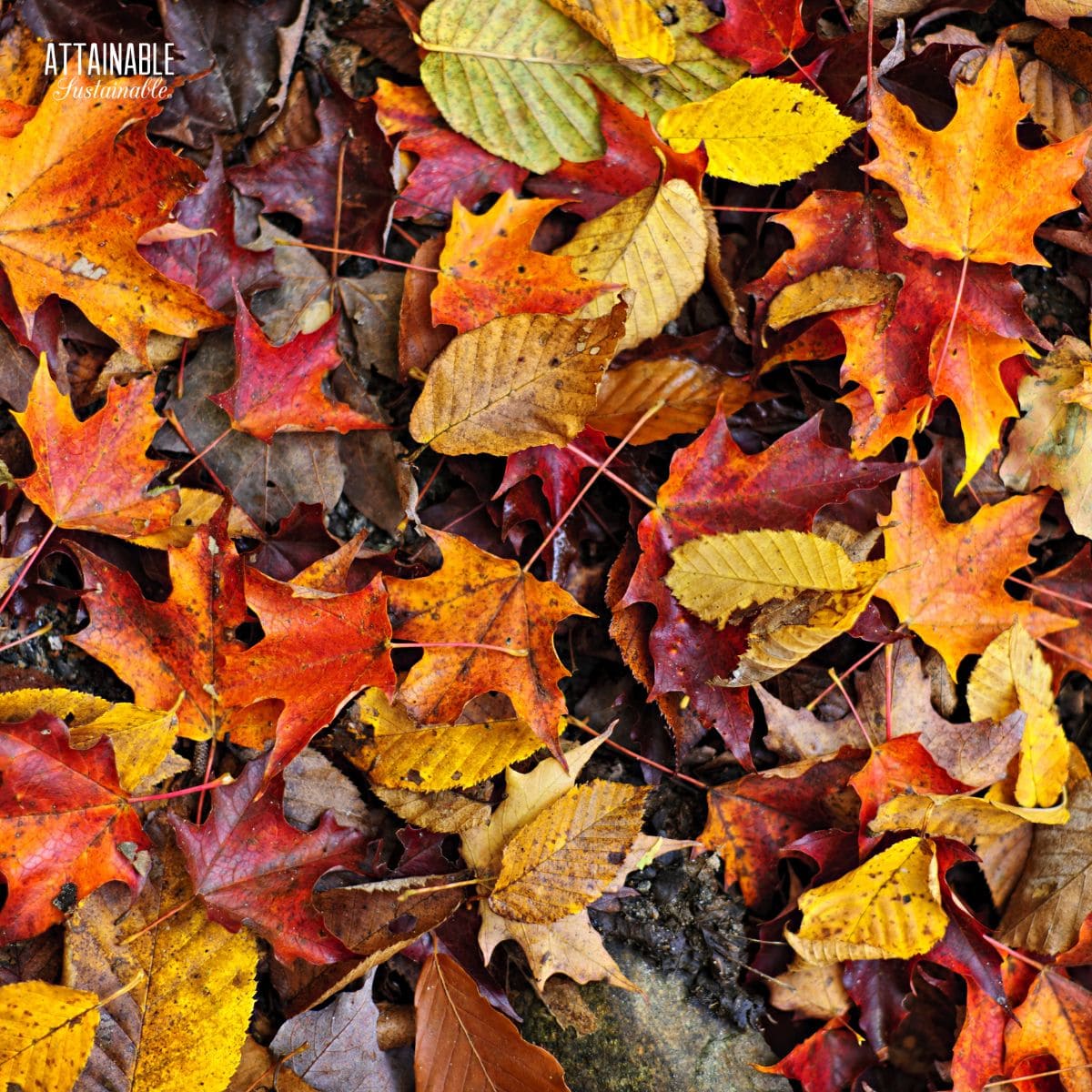
For years we lived in a rural area that meant a longish drive on a country road to get home. In the autumn, one resident on this winding country road – a stranger to us – seemed almost to wait for fall leaves. As soon as the deciduous trees started dropping their leaves, the homeowner started raking. And piling. And burning. The damp leaves would sometimes smolder for days, filling our canyon with a smoky haze.
At the time, I didn’t stop to introduce myself or suggest alternatives; I just grumbled as I drove by. Shame on me. Now I realize that she probably didn’t know what an asset she had right there in her yard.
The first thing to address is this: If you can leave the leaves in place, do that! Allowing leaves to remain where they fall means that the insects and critters that rely on those leaves to overwinter have a place to do so. Those leaves are both food and shelter to butterflies, moths, bees, and more.
If you rake them up to turn into shredded leaves – either in the fall or as winter comes to an end – you may very well be removing cocoons and larvae that need those leaves to survive.
Grow Some Greens!
Ready to grow fresh greens, no matter WHERE you live? Sign up for my
FREE quick-start guide and start growing some of your own food!
It’s perfectly okay to relocate the leaves if you need to clear a path or lawn area. Just leave them in piles in an area where they won’t be a bother.
If you can leave the leaves in place, they will act as a natural mulch, help suppress weeds, and add organic matter to the soil. Think about the rich soils in forests, where nobody is raking.
Using Leaves in the Garden
If you must clear the leaves, as many who live in subdivisions do, slow your roll!
Fallen leaves are a terrific resource for gardeners. If you’ve got fall leaves beginning to drop don’t view them as a nuisance to get rid of as quickly as possible. Look at them as an asset falling from above.
You can use leaves in the garden as mulch and add them to your compost, but even if you don’t plan to use them, don’t let this abundant source of organic matter go to waste; call a friend! Put them in biodegradable leaf bags and deliver them to your favorite gardener. I guarantee he or she will be thrilled at the opportunity to make some leaf mold for their garden.
Fall Leaves for Mulch
In the fall, while my neighbor down the road was smoking up the joint, I piled dry leaves 6-12″ deep around the base of my raspberries. Sure, a few blew away. But come springtime, those leaves had completely broken down into a rich leaf mold. And the soil around the base of each plant was soft and rich and weed free.
Using leaves in the garden around plants enriches the soil as it holds down weeds. Plus, the resulting leaf mold helps to retain water.
You can pile leaves on all of your vacant raised beds, too. By springtime that organic matter will be largely decomposed, resulting in a lovely leaf mold that will boost soil quality.
Protect Tender Plants
You can help insulate tender plants from the ravages of winter by piling on leaves. This doesn’t mean you can grow bananas in Alaska, but if you have some specimens that are borderline for your growing zone, surrounding them with dry leaves will provide a bit of protection.
Simply cover low-growing plants with leaves. For taller plants, create a wire cage around the plant and fill that with leaves.
Make a Lasagna Bed
No need to plant anything in it; just get it started. Come springtime you’ll have a beautiful bed in which to plant veggies. The leaves will have transformed into a lovely leaf mold that will improve your soil’s structure.
Organic Matter
If you don’t have a garden space that would benefit from mulch right now, you can add the leaf litter to your regular compost pile and let it sit over the long winter months.
Crispy fall leaves are an excellent source of carbon to add to the compost pile. I always seem to have plenty of nitrogen additives for the compost, but have a harder time acquiring a carbon source. If you have a similar problem fall leaves might be the answer.
Making Leaf Mold
Make a big pile of leaves and let Mother Nature do the rest.
By springtime, that pile of leaves will be greatly reduced in size and you’ll have wonderful leaf mold to add to your garden. To prevent leaf piles from blowing away, place the leaves in a wire bin or cover with a tarp tacked down at the edges with rocks or bricks.
Don’t want to use plastic? You can use an old cotton sheet. (Just be aware that it will start to decompose.)
Once the leaves break down over the winter, you can use the leaf mold mulch as a soil amendment in the garden to help retain moisture and improve soil life.
Feed Your Worms
Depending on the size of your vermicomposter, this won’t take care of a yard full of leaves, but the worms will absolutely go to town on what you offer.
Green Waste
If all else fails, and you really, truly can’t find something better to do with the abundance of leaves, bundle them up in biodegradable bags and send them to your local green waste facility rather than sending them to the landfill in bags.





I live in Houston, Texas and the lawn soil here id clay like. I’d like your recommendation[s] on how I can best break down the clay to a more nutrient soil. I want to be the best lawn on the block.
We mulch our leaves….we have tonnes of them. Then they go into our gardens. My flowers bloom like crazy all through spring, summer and autumn. I also cover my vegetable garden to keep down the weeds and in spring rake up whatever may be left behind. Then it goes into the compost pile. Burning is wasteful.
Ash from burned leaves would be great for all gardens, as well as ash from wood burning fireplaces.
The number about how 6-12 inches of mulched leaves being completely composted by spring is very far from the truth. In Michigan, that would never happen!
What would the leaves look like come Spring in Michigan?
A three inch thick packed mass of leaves. Also, stand by to reseed your lawn.
We just throw ours over the fence into the garden or mow them on the lawn because we live in the Sandhills of North Carolina and have more sand than soil! I have always loved to walk through leaves – I called it “crunching’ when I was a child.
We use them for mulch and lasagna gardening. For faster composing, run over them with a mower a few times. They’re shredded into much smaller pieces, which means easier handling and faster decomposition. If you don’t want to mulch with them, mow over them anyway and leave them right on the lawn. They provide important nutrients and are almost entirely broken down by spring if left in a thin mowed layer on the lawn.
I used to live in a place with a similar situation – my neighbor would rake up all her leaves and burn them. When I complained, she told me she had a permit from the fire department. The smell and the smoke were too much to bear if the wind blew in the wrong direction (which it usually did. Go figure).