
Discover how to grow bean sprouts right in your kitchen to add crunch to your favorite stir fries.
Originally published in January 2016; this post has been updated.
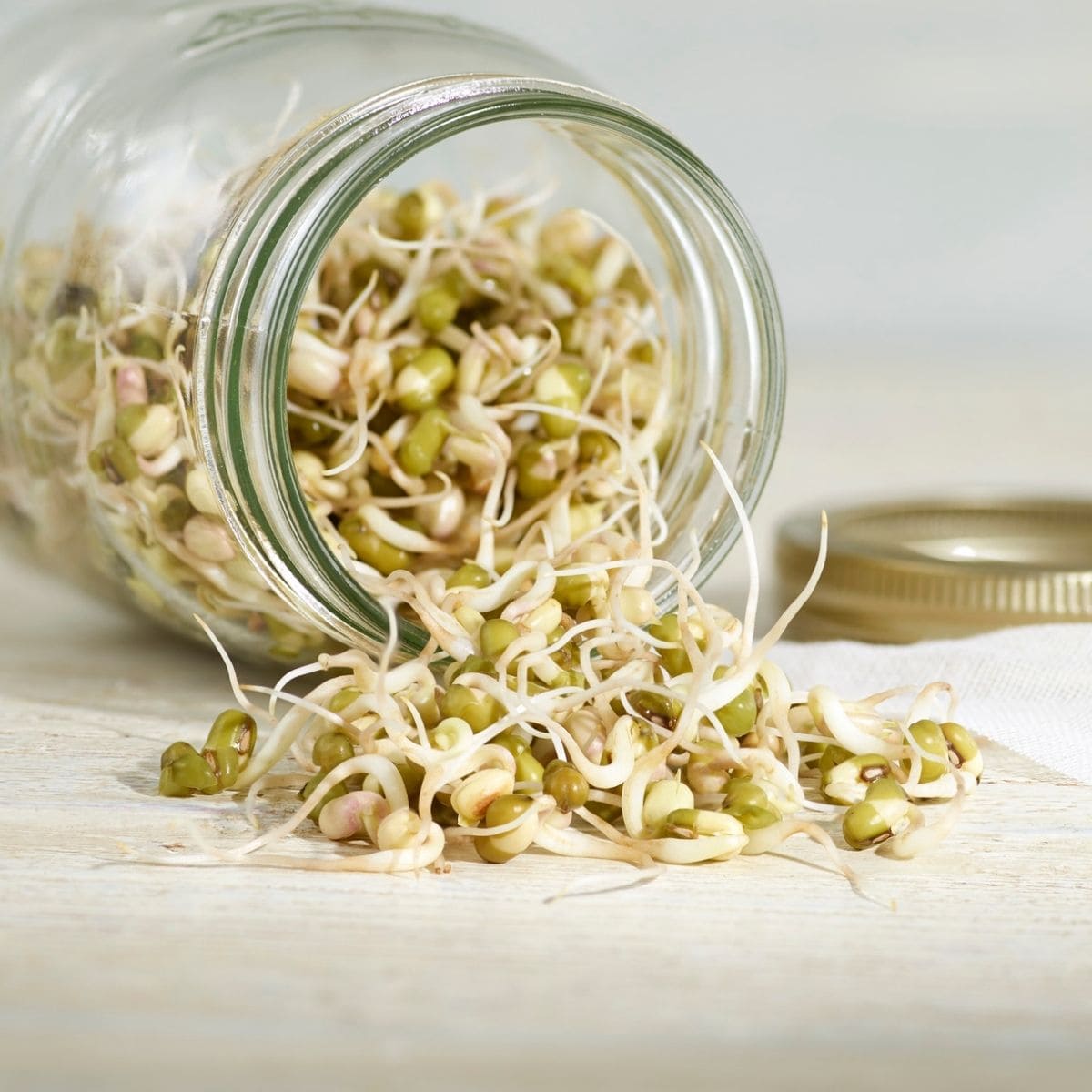
Growing bean sprouts at home is a perfect activity for apartment dwellers who want to grow some of their own food and it’s a great way to have some freshly harvested produce year round.
Before diving into how to grow sprouts, I think it’s important to discuss safety.
The conditions in which bean sprouts grow are also conducive to the growth of bacteria like salmonella, E. coli, and listeria.
Just being careful and clean in your kitchen isn’t enough to eliminate these risks. Outbreaks of disease often come from contaminated seeds.
Grow Some Greens!
Ready to grow fresh greens, no matter WHERE you live? Sign up for my
FREE quick-start guide and start growing some of your own food!
The first safety suggestion I have is to be sure to use seeds specifically for sprouting from a source that regularly tests their stock for contamination.
The University of Missouri has some guidelines for treating seeds to reduce potential pathogens here.
A sure way to avoid any risk? Cook your sprouts instead of eating them raw. They are a great addition to stir fries!
If you’re looking for a way to grow some fresh produce on the kitchen counter that you can comfortably consumer raw, consider microgreens. These are grown in soil and less likely to harbor bacteria.
Jump to:
- Growing bean sprouts
- Step by step: How to grow bean sprouts in a mason jar
- How to store your bean sprouts
- Cooking with sprouts
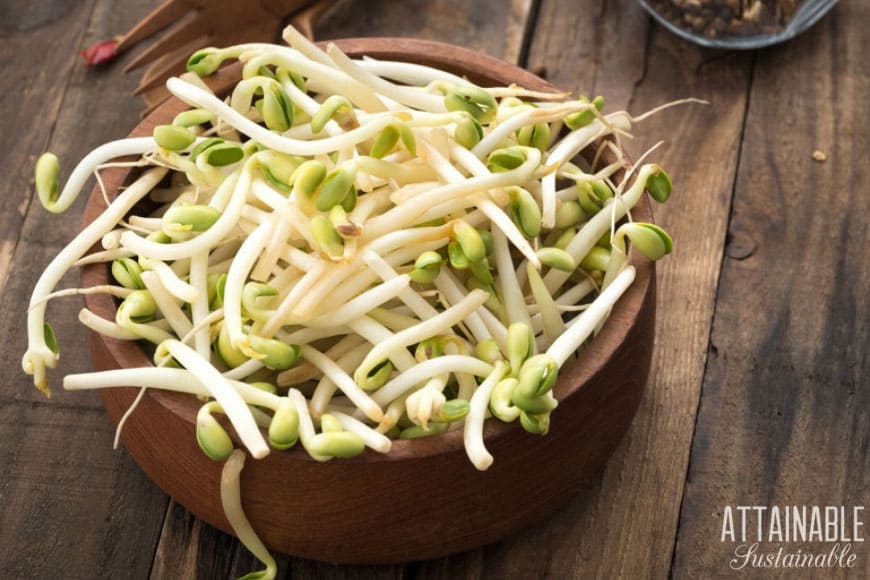
How to Grow Bean Sprouts
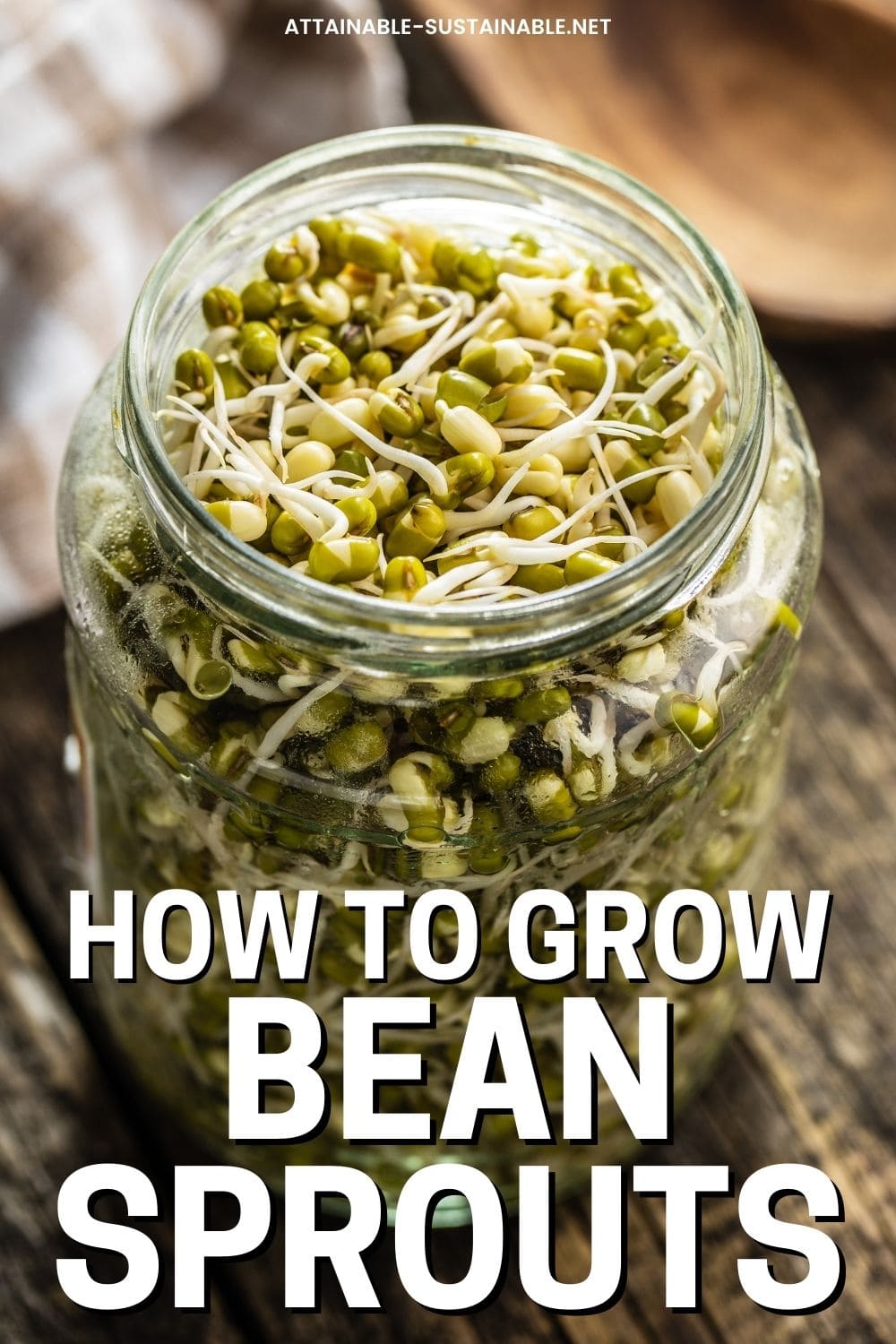
You can sprout mung beans on your kitchen counter in as little as four days. While using a fancy automatic sprouter can make the job mindless, you don’t need any special equipment to be successful. You can start growing sprouts in a mason jar or a cotton bag.
Once you’ve learned how to grow bean sprouts, you’ll be able to sprout a variety of different beans, all winter long. They are crunchy, nutritious, and rich in antioxidants. (You might also want to try growing microgreens, like these sunflower sprouts.)
Step by Step Guide: How to Grow Bean Sprouts in a Mason Jar
- Wash a wide mouth mason jar or upcycled glass jar and rinse it well to remove any soap residue.
- Prepare a piece of window screen to fit your wide mouth mason jar. Draw a circle on the screen using the mouth of the jar as the pattern, then cut around the circle. If you don’t have spare window screen laying around your kitchen, you can order them online.
- Place two tablespoons of dried beans in a clean jar.
- Place the screened lid on the mason jar. Alternatively, attach several layers of cheesecloth atop the jar with an elastic band.
- Fill the jar ½ full with fresh water. Let the mung beans soak overnight.
- The next day, rinse the mung beans and invert the jar in a bowl to drain excess water. Once drained, return the jar to its upright position and let sit at room temperature.
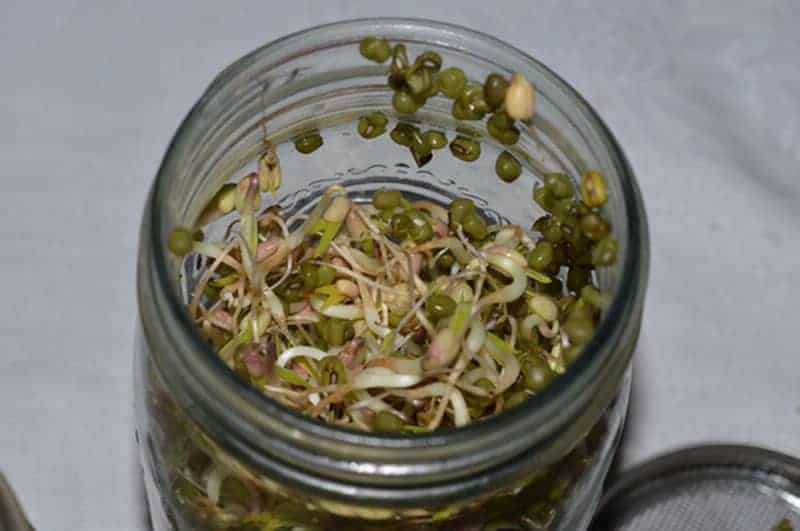
- Rinse and drain the soaked beans in clean water twice a day for 4 to 6 days. The mung beans are ready to eat when the white sprout is at least 1.5 cm long. At this length the lectins in the bean are converted into digestible proteins. You can grow the sprouts longer if you wish; it takes about five days for them to get 3″ long.
- If the sprouts are exposed to direct sunlight while they are growing the leaf tip will turn green on days 5 and 6. If kept in a dark place, they will remain white, like store bought sprouts.
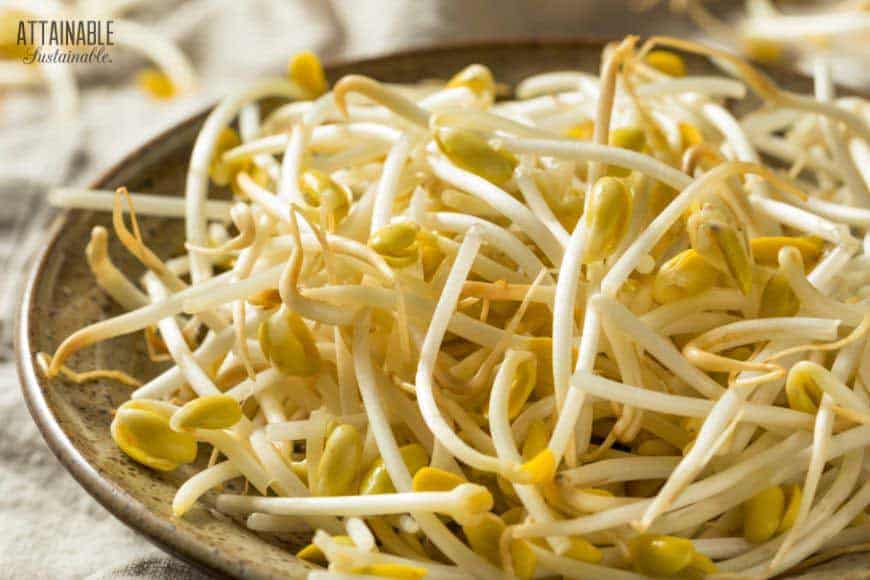
Storing Bean Sprouts
Any time after day four, replace the screened lid with a normal mason jar lid and place the fresh bean sprouts in the fridge. It’s a good idea to place a dry cloth or paper towel in the jar with the sprouts to absorb excess moisture.
Rinse them once a day to prevent them from drying out. Eat them within a week.
Cooking with Sprouts
Bean sprouts are perfect to add to fried rice dishes, make a bean sprout stir fry, or add some to homemade pho or pad Thai. Or you can enjoy them lightly steamed.
Add sprouts to your cooked dish just before serving.
★ Did you love this recipe? Be sure to give it a star rating below! ★
Growing Bean Sprouts at Home
Ingredients
- 2 tablespoons mung bean seeds or lentils
Instructions
- Wash a wide mouth quart-sized mason jar and rinse it well to remove any soap residue.
- Prepare a piece of window screen to fit your wide mouth mason jar. I use polyester window screen on my sprouting jars, drawing a circle on the screen using the mouth of the jar as my pattern. I cut around the circle. Then my sprouting screen is ready to use. If you don’t have spare window screen laying around your kitchen, you can order specially made sprouting screens online.
- Place bean seeds in a one-quart mason jar.
- Place the screened lid on the mason jar.
- Fill the jar ½ full with cold water. Let the mung beans soak overnight.
- Rinse the mung beans in the morning and turn the jar upside down to drain.
- Rinse and drain your bean seeds twice a day for 4 to 6 days. The mung beans are ready to eat when the white sprout is at least 1.5 cm long, but they can be grown out until they're 3" long.
Notes
- If the sprouts are exposed to light while they are growing the leaf tip will turn green on days 5 and 6. If the sprouts are kept in the dark, they will remain white, like the bean sprouts from China. I like my bean sprouts to be a bit green.
- No sprouting lid? You can simply cover the top of the jar with several layers of cheesecloth fastened in place with a rubber band.
- Store sprouts in the fridge for up to a week. Rinse them once a day to prevent them from drying out.
DIY Sprouts and Microgreens
Growing these tiny greens is an excellent way to have a year-round harvest!
- Bean Sprouts
- Lentil Sprouts
- Broccoli Sprouts
- Sunflower microgreens
- Popcorn microgreens
- Growing microgreens



Looks delicious!
Hi Kris, can you sprout any kind of bean? I have an abundance of organic homegrown beans, dried, from my garden.
Thanks for the great article!
Cynthia
I bought Masontops Bean Screens on Amazon. They work pretty well, although rather pricey. (No, I’m not a shill.) Easy to fill, easy to drain. The one thing I don’t like about sprouting in a jar is that you can’t get weight on the beans to create nice, thick bean sprouts.
Any tips for removing the bean remains prior to eating? Or do you eat them too?
Those are eaten as well.
Could you use cheese cloth in place of a window screen?
You could try it and see how the rinsing and draining go, just keep your eye out for mold.
Is there a trick to getting the sprouts to be thick like the ones in store vs. like little hairs? we have sprouted as directed but have never been able to get any width or thickness on the sprouts as we are accustomed to for pho.
It’s hard for me to know from here, but I’m wondering if you are growing a different variety? Otherwise, keep them growing! Good luck 🙂
from the Chinese grocery labeled mung beans, we did finally get some substance on some of them just by being more patient, but also have a lot of leaves. But they worked in our pho earlier this week. Time seems to be the answer. thanks.
In a different one, someone put a weight on top of them to make them grow thicker.
That’s worth a try!
Hi. I bought mung beans from Asian grocery store. They said yes, yes they will sprout. It was $5 for bag half size of loaf of bread. But they don’t sprout. I want bean sprouts like I get in the store. Where do I get mung bean and lentil that will sprout? I live in Saskatoon, Saskatchewan Canada
I don’t know where in your area, I’m sorry. You will want the bean seeds, I recommend organic. Good luck!
It seems that the most popular sprouting seeds in Canada come form Mumm’s Sprouting Seeds in Parkside, SK (sprouting.com). I just bought them and haven’t tried them yet, but you should be able to find them at a health food store.
I got mine online like Amazon. They do have a shelf life of a few years. If you don’t plan on growing them every week buy a quart bag or less.
Hi I’ve got some mustard seeds I use for cooking can they be sprouted ?
Cheers
Darron
Yes, that should work!
In pictures 1, 3, 4 and 5, some of the sprout heads are brown / purple, but the sprout heads in the final pictures are yellow or green. Is the brown / purple color normal and not a sign of infection?
Yes, it’s a normal color variation and nothing to worry about. Good luck sprouting! 🙂
I’m looking for the best and affordable seeds for growing fodder in a wood frame for my chickens.
Can you suggest where to buy? I’ve looked of course on amazon, but don’t see anything less than 15-20 $ for a lb which I know I need more than a lb.
This post might help answer some of your questions: https://www.attainable-sustainable.net/sprouting-grains-fodder/
I know the longer you wait the more sprout, but about how much final product do you get with 2 Tablespoons of dry bean?
It really depends on how long you let them sprout, and how much you want! They grow quickly, but if you find yourself wanting more you could always do 2 jars at once a few days apart. 🙂
Step 5. How do I add water half way in the jar if on
Step 4. I already Place the screened lid on the mason jar
Is step 4 & 5 reversed or backwards?
They’re kind of interchangeable. You can run water into the jar through the screen.
Hi, I have a hard time growing sprouts any bigger than about 1,5-2 cm .. they developed strong roots and I really don’t like them with the roots – do you cut them?
You might prefer growing microgreens! https://www.attainable-sustainable.net/microgreens/
Any thoughts on eating bean sprouts if you’ve forgotten them for more than a week? I now have small plants, about 4″ long, with leaves on – what should I do with them?
They really need to be managed daily (as I think you figured out!). I’d compost them.
I’m trying this for the first time with lentils! Does it matter that my tap water is chlorinated?
Thanks!
It shouldn’t, but you could always set the water out uncovered overnight to let the chlorine dissipate.
Most municipal water systems use chloramine rather than chlorine nowadays. That won’t dissipate. You’d need a water filter to get rid of it.
Noted!
Do you keep the bean sprouts in water after the first 12 hrs or just rinse and drain everyday?
Not in water, no. Drain every day.
I received a large sprouting package as a gift from a friend. The thing is, I wasn’t a big fan of raw sprouts. The texture is nice, but the flavor never appealed to me…….But, being the nerd I am, I decided to try your method. It worked beautifully. I used cheesecloth because I have an abundance of it, but changed it once a day, carefully, to avoid any issues.
The sprouts grew so well that I decided to try flavoring them. So, I went the pickling route using different recipes. Some spicy, some Asian, some in the garlic kosher style……Now I put the sprouts on almost everything or just as a small side dish……. A favorite at family gatherings is my Korean sprout pan-fried dumplings. Just add an equal amount of pickled sprouts and appropriately spiced cooked protein (garlic and onion never fail), and just let them fry a couple minutes on each side.
The rinsing regimen came easy. First rinsing when I’m making the coffee—second when I’m done doing the dinner dishes.
I’m glad you found a way to love them!
Hi Kris, thank you for creating this post. I’m new to sprouting. What happens if you forget to change the water for the 1st 12hrs? Is it unsafe to eat them? Thank you for any guidance you can provide.
It shouldn’t be unsafe if you miss the exact timing. Just be mindful (hello, calendar reminders!) to change regularly to prevent sliminess and potential bacterial growth.
Can you still eat them if they grow little green leaves?
Yes, though they might be a bit tougher.
Love your ideas and I’d like to try growing sprouts! Is there a reason you need screening not cheesecloth in the top?
Cheesecloth can work, but in certain climates may tend to mildew. It’s also not as easily reusable.
I love your article. I’ve been growing sprouts and microgreens for a few months. So exciting. Just thought I should say that I grow red lentils. They are really easy. I main,y grow them a microgreens but have also grown them as sprouts. I just got them from the supermarket.
Where is the easiest place to find these seeds? Home Depot nurseries? Where? I’ve sprouted for years, but never considered the organic and GMO free aspects. Thanks for your article!
Natural food stores usually have them, if you have one near you. Or Amazon has a big selection: https://amzn.to/2nMYRAe #ad
I bought barley at Winco,,it has been over a week..no sprouting.Either Barley doesn’t sprout or the seeds I bought (in the bulk food dept) were GMO
It might be a leap to say it’s GMO. To my knowledge, barley is not transgenically altered. Was it organic? Sometimes grains are treated to prevent insect damage/spoilage (organic ones shouldn’t be). Did you get *whole barley, not the kind you’d put in soup? Like this: https://sproutpeople.org/barley-grass/
They are not normally GMO but unless they were organic they were probably killed with glyphosates on the stem to make harvesting easier.
This pictures in your article are wonderful! And, I have always thought of sprouts as the ultimate easy source of year round mega nutrition there is.
Those pictures are from Chris! Inspiring, no?
This is probably a silly question, but do you leave the jar upside-down (over a bowl or something) to continue to drain constantly, or do you turn it back upright once it’s well-drained?
I do both. If I have room on my dish draining rack, I leave it upside down on the rack until I need it again. But if I don’t have room I leave the jar upright on the counter. I have a friend who leaves her jars on their sides, on the back of the kitchen counter, so that the sprouts grow up on the side of the jar. But I have a smaller kitchen and not as much counter space.
The main concern about draining them is that you don’t want them sitting in a puddle of warm water, because of the possibility of bacterial growth.
Ive grown Broccoli sprouts in jars at my place, it was an interesting exercise but not something I found sustainable… https://bit.ly/1t8VHkI
Where do you buy the seeds to sprout?
You can get them at the health food store, if you have one. You can also order them online. Here’s just one collection: https://amzn.to/1SteO3K
I buy them at either an oriental store or an Halal/Kosher store i.e. Pakistani or Indian store, I get 2 pounds for $3.99 in my area.