Blog Archives

Deep Watering in the Garden

Deep Watering in the Garden

I’ve mentioned before the fact that my soil has a hard time holding on to moisture. Between that and the fact that some of my veggies are planted on a slope to utilize as much of our space as possible, getting water to the roots of my plants – and keeping it there for a moment – is difficult. By deep watering with a container sunk into the soil, I can direct the water right where it needs to go instead of wasting it as it runs off down the slope. To try this method, you’ll need a container of some sort. I used a 1.5 liter plastic bottle (cut in half) but you could also use a 1-gallon plastic plant container, a large tin can (the oversize kind you’d get at Costco or a big pineapple juice can), or a  half-gallon milk jug. Poke three or four small holes in the bottom of the container. Dig a hole alongside the plant you’d like to deep water, being careful not to disturb its roots. Sink the container in the ground, leaving only about half an inch above ground level. Fill around the container with soil. When your garden is...

Read more »

Switching from Boxed and Canned to Homemade

Switching from Boxed and Canned to Homemade

Basing my assumptions on a trip through the grocery store, it looks like much of America begins the process of “cooking” with something that comes in a box or a can. Mother Nature does not produce food that comes contained in a box; this is purely a human invention to a) speed up the process of getting dinner on the table and b) make tons of money for the company that produces the product. Cooking from scratch is really very easy, and I’ve found that once I learn a new recipe, it doesn’t take that much longer than using the store bought shortcuts. The deal is, you have to make a recipe several times before it becomes as second nature as opening a box or can. Wondering what recipe you can switch to homemade without losing hours of time to prep work? I’ve eliminated these convenience items from my cupboard with very little trouble. Pancake mix: I grew up on Bisquick and Krusteaz pancakes, but started making my own from scratch twenty years ago and never looked back. Following the recipe in my Betty Crocker cookbook, it might take me a full minute longer to follow the recipe than...

Read more »

Save that Water!

Save that Water!

Instead of pouring the water that you’ve used to cook hard boiled eggs, vegetables, or pasta down the drain, allow it to cool and then use it to water some of your outdoor plants. Alternatively, you can use the boiling water to kill weeds. Just pour the hot water onto driveway cracks or other weedy areas (NOT near plants you’d like to keep!) for a chemical free weed killer.

Read more »

Combat Poor Soil with Lasagna Beds

Over on my Facebook page, Catherine laments the fact that her clay soil isn’t good for gardening and her budget just doesn’t allow for hiring a big piece of equipment to turn and improve the soil. While I don’t have clay soil, I’ve mentioned before that our soil is puny. When we first moved in, I wanted to get some plants in the ground right away, but knew that I’d need to improve the soil for better success in the long run. I’d read about lasagna beds (called such because the beds are layered, much like a lasagna) but had never tried them. This seemed like a perfect chance to try them out, and they may be the answer to Catherine’s troubles, too. Unfortunately, I didn’t take any pictures of my lasagna bed process, but I can tell you how I did it (with thanks to Kelly at Kitchen Garden Table for tips!). I started by raiding my recycle pile. Cardboard boxes, newspapers, and even old catalogs form the base of the lasagna bed. I covered my planting area with a thick layer of these paper products, overlapping them as I placed them down, and then wet them thoroughly....

Read more »

Utilizing the Garden Space You Have

Utilizing the Garden Space You Have

When we moved into this house, the very steep front yard was filled with pineapple plants (undeniably cool, I know). It was probably an easy way for the previous resident to use the awkward space, but we wanted more productivity from the only sunny spot in the yard. The pineapples ripened over the course of several months, and as they did, we pulled out the plants and shared them with friends and neighbors. We still have some pineapple plants, tucked here and there, but large-ish plants that bear only a single fruit just isn’t the best use of our small space. Instead, we’ll focus on plants that will offer a lot of produce for the space they take up in our yard. Of course, this year, our first full gardening year in the tropics will be a little bit of trial and error – my “high yield” crops from a past life might not live up to expectations here, but based on years of gardening on the mainland, these vegetables get high marks for high yields: Tomatoes – Caged and supported, a tomato plant takes up roughly a 2′ x 2′ piece of ground and produces a steady flow...

Read more »

Chicken Tractor in a Pinch

Chicken Tractor in a Pinch

So, I’ve got chickens. I’ve raised egg laying chickens for more than a dozen years but I’m finding it to be a bit of a challenge here in suburbia. Mostly because the chickens are refusing to follow directions. See, we have little in the way of predators, so unlike some of you, I don’t need a coop as solid as Fort Knox. I’ve been letting them roam free around here and they’re doing a fine job of keeping down the slugs (slug eggs? Like chicken caviar!) and bugs. But these chickens, they have a mind of their own. They’ve snubbed my suggested nesting boxes and made their own comfy spot to lay. They insist on scratching in my garden area, tilling up seedlings and making me crazy. And now they’re venturing into the neighbors’ yards. I needed a way to contain them without building a big, expensive coop, something I could put together quickly and before my neighbors start giving me stink eye. I like the idea of a chicken tractor, so I can keep them contained and yet offer fresh grass. Necessity, meet invention: Tacky? Absolutely! But it took me, alone, less than an hour to implement this...

Read more »

Egg Carton Conundrum

Egg Carton Conundrum

If you don’t raise chickens for eggs, you can make a more sustainable choice at the grocery store. For goodness sake, stop buying eggs in Styrofoam! You may pay slightly more for eggs in fiber cartons but those cartons can be composted! And if your neighborhood egg sellers are offering you eggs in plastic (one of the dumbest things marketed to egg people), let them know that you’d prefer yours in a basket.

Read more »

Save Your Seedlings from Bugs

Save Your Seedlings from Bugs

Something has been munching my seedlings and transplants off right at the ground, so I’ve been using cardboard toilet paper tubes to foil the little buggers. When planting large seeds like melons or squash, I push a section of tube (I cut the rolls in half) into the soil so about 1/2″ of the tube is above ground level and then plant my seed inside the tube. I do the same with small transplants, making sure not to damage the roots as I push the tube around the plant. The tube will decompose over the growing season. It does work. I planted out three small pepper plants the other day, but only used a cardboard ring around two of the plants. The third, unprotected pepper was gone by the next morning. To use this method with bigger transplants, just cut the ring open and slip it over the plant’s stem.

Read more »

Soup Smarts

Soup Smarts

When it’s time to clean up after dinner, we often have small amounts of vegetables or sauces left in the pan. Not quite enough for a leftover lunch, but enough that I don’t want to waste it. Instead of storing these little bits in the fridge, only to throw it out a couple of weeks later once it’s gotten suitably moldy, I keep a container in the freezer where I collect these odds and ends. Green beans, sliced onions, mushrooms, pasta in marinara sauce – it all gets tossed into the same container. When I use a jar of marinara sauce, I rinse the jar with a little bit of water and pour it into my freezer soup pot. When I make pesto sauce, I add a cup of water to the blender and run it to clean off the remaining sauce and I pour in, too. The trick is to make sure you’re not mixing flavors. I wouldn’t, for instance, mix leftover enchilada sauce in the same container that I’ve saved pesto. Instead, I keep an “Italian style” container and another for “Mexican style” flavors. When I make soup, I simply add my container of leftover bits (never...

Read more »

Ten Tips for a Healthy, Sustainable Diet on a Budget

Ten Tips for a Healthy, Sustainable Diet on a Budget

Over on the Attainable Sustainable Facebook page, I posted this video of Robyn O’Brien discussing America’s food system at TEDxAustin. It’s a very compelling video in which Ms. O’Brien offers a calm and concise look at the foods we’re feeding our families. For instance, did you know that genetically engineered corn is regulated by the EPA as an insecticide because it releases insecticides as it grows? Tortilla chips, anyone? After seeing the video, Sophia, one of my Facebook followers wrote: How can the average (poor) family of five eat on healthier food? I’m wanting to, but stumped. It’s a valid question. Learning about some of the atrocities in our supermarkets is the surest way to convince oneself that organic is the way to go. But organic food is expensive. It’s a sad day when food grown and prepared naturally is the alternative and not the norm, but that’s a whole ‘nother story. I live in a state that is notorious for its high food prices, so I’m all too aware just how costly it is to eat well on the cheap, but some of my tactics may work for you: Stop buying food products and start buying real food....

Read more »

Join Me!

e-book

Free Email Alerts!

Click 'subscribe' once, then check your email for a confirmation message.

Welcome

It’s one thing to think, “Hey, I’d love to be more self-sufficient!” and quite another to implement a lifestyle change that might require learning some new skills.

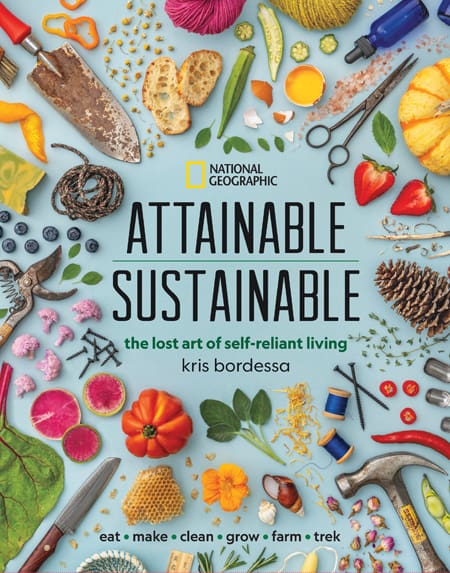
Attainable Sustainable is about bridging the gap between wanting change and making it happen without becoming overwhelmed. Nobody’s saying you have to go get a tractor and a cow. Attainable Sustainable is about discovering – one step at a time – how to make changes in your life to support a sustainable lifestyle.

The Author

Kris Bordessa has been gardening for most of her life. She's been authoring books and writing features for the past ten years or so. It's about time she combined the two, don't you think? [More about the author]