
Infused vinegar is super easy to make. It’s a simple matter of combining the right ingredients and allowing the flavors to meld over time. Gourmet vinegar makes great gifts; it’s so much less expensive than the store bought flavored vinegar.
You might even want to try it in this recipe for caramelized onion jam with balsamic vinegar.
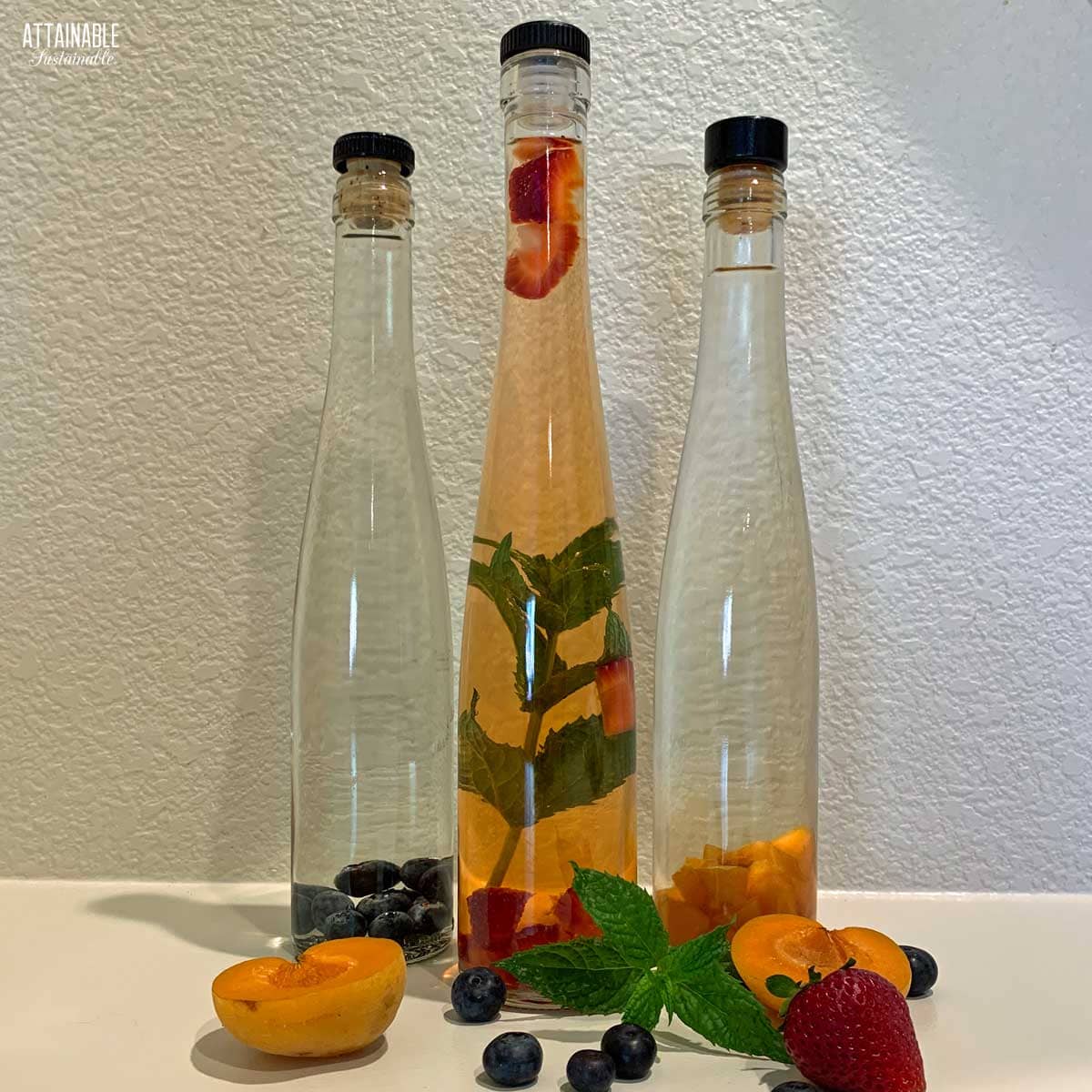
Gourmet flavored vinegars available at specialty stores can be expensive to purchase, but they add so much flavor to recipes. The good news? You can make your own infused vinegar at home for less!
 Ready to DIY your pantry with more wholesome ingredients? Check out my new book from National Geographic! Attainable Sustainable Pantry is filled with delicious recipes for some of your favorite condiments, snacks, and toppings, along with an entire section on safe home food preservation. It’s the guide you need to start skipping packaged products and embrace homemade.
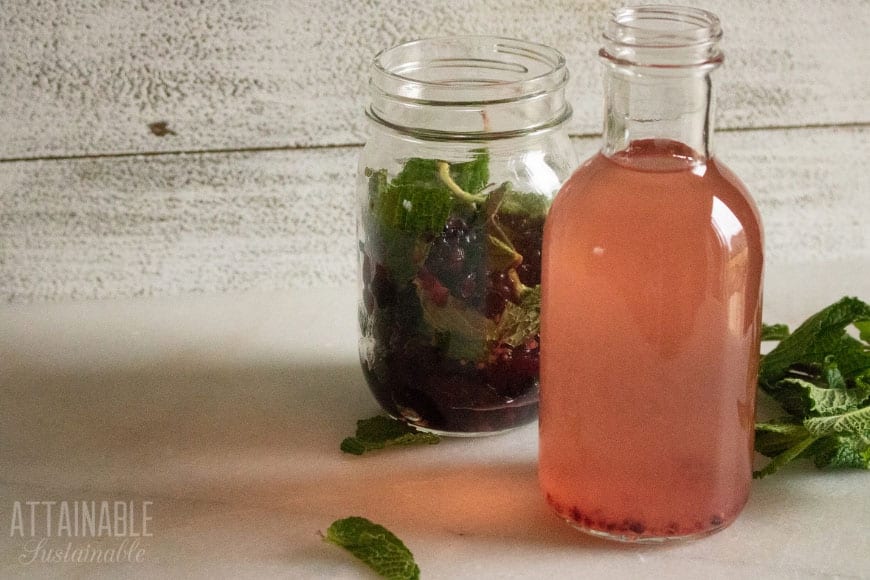
Flavored Vinegar Infused with Fruit & Herbs
With endless flavor possibilities, infused vinegars impart a delicious flavor to salad dressings and marinades. They’re a great way to add extra oomph to roasted or steamed veggies. Or use them to take pasta salad up a notch.
Choose your Vinegar
Traditional balsamic vinegar hails from the town of Modena in Italy. The process of making it is complex but nets a mild and sweet flavor. White balsamic vinegar is the best choice here and pairs well with the sweetness of fruit.
White vinegar, red wine vinegar, or apple cider vinegar are also good options, though these vinegars are a little more harsh in the mouth than balsamic vinegar. To temper the sourness of the vinegar you can add a little bit of sweetener to solve that.
Get a Quick Start Guide to Safe Canning!
Want to learn how to preserve the harvest? Dive in for a look at various canning techniques and methods! Grab my FREE 6-part guide to getting started.
Each type of vinegar will offer a slightly different flavor, so experiment!
Apple cider vinegar pairs especially well with fruit. Be mindful of this little tidbit when buying apple cider vinegar.
Choose your Fruits and Herbs
Fruits — Soft fruit like berries and stone fruit work really well. Don’t hesitate to mash the fruit slightly as you add it to the jar.
Herbs and spices — Adding fresh herbs or whole spices in combination with the fruit or as a flavor all its own ramps up the flavor. Avoid using ground spices as these can cause the vinegar to become cloudy.
Vinegar Flavors to Try
The sky is the limit here. You can do single fruit flavors like strawberry vinegar or do a mix of fruit, based on what you have on hand.
Making flavored vinegar is a great way to use up small amounts of fresh fruit before it goes bad.
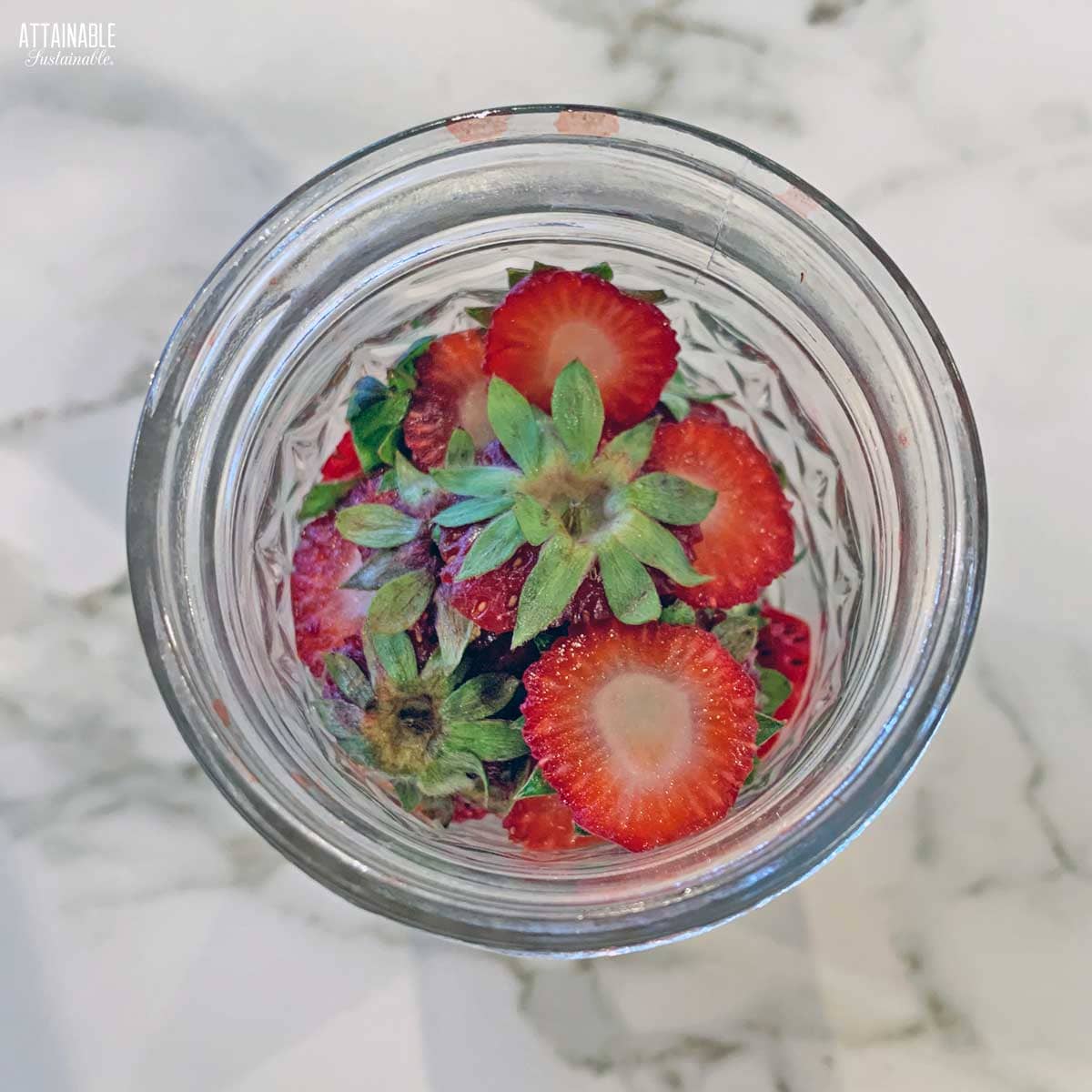
- Strawberry mint: Use whole berries or be extra frugal and use the hulls of strawberries from another strawberry recipe.
- Lemon mint: Combine mint and lemon zest for a delicious combo.
- Lemon thyme: A savory combination perfect for using in salad dressings or marinades.
- Apple cinnamon: Use chunks of apple and whole sticks of cinnamon.
- Blackberry basil: This is a great way to salvage berries that are getting too soft for fresh eating.
- Hot pepper vinegar: Use your favorite type of hot pepper. The heat will vary depending on the type of pepper and how much you use.
- Rosemary garlic vinegar: Sprigs of fresh rosemary pack a flavor punch.
- Cranberry vinegar: Perfect for making a holiday salad dressing.
- Strawberry orange: Combine strawberries (or strawberry hulls) and orange zest.
- Cranberry orange vinegar: Orange zest and cranberries are delicious together.
- Pear peppercorn: Combine ripe pears with whole peppercorns.
- Peach pie: Combine chunks of ripe peaches with cinnamon sticks, whole allspice, and whole cloves.
Infusing Vinegar
This is more of a method than an actual recipe. You can use less fruit or more fruit, depending on how much you have and how strong you’d like the fruit flavor to be.
You can use a small amount, say a cup of fruit, in a quart of vinegar, or loosely fill a jar with fruit and pour vinegar over to cover it. There’s not a single correct way to do it.
Berries can be used whole, but should be gently bruised to release more flavor. Larger fruit should be cut into smaller pieces.
Allow the fruit to infuse in the vinegar for at least two weeks, or up to a month. Once enough time has passed, strain vinegar through cheesecloth or a fine strainer to remove the solids.
Store strained infused vinegar at room temperature for up to three months. Refrigerating the vinegar will extend its shelf life to 6-8 months.
Packaging Flavored Vinegar for Gifts
This is, as you’d imagine, a delightful gourmet gift for the chefs you love. Flavored vinegar can be bottled up in pretty upcycled jars. Tie on a tag identifying the flavors and wrap it up. (Here’s a cute way to wrap the bottles!)
★ Did you make this infused vinegar? Don’t forget to give it a star rating below! ★
Flavored Vinegar Infused with Fruit & Herbs
Ingredients
- 4 cups vinegar see notes
- 1 - 3 cups fresh fruits or herbs
- ¼ cup sugar optional
Instructions
Infuse the vinegar
- Gently warm the vinegar in a pan on the stove, until it just begins to steam. Don’t let it simmer or boil.4 cups vinegar
- Place the fruit in a clean and sanitized wide-mouth mason jar. Use a muddler to tamp down the fruit to release a little juice. if you're using sugar to temper the vinegar (see notes), add it now.1 - 3 cups fresh fruits or herbs, 1/4 cup sugar
- Pour the warmed vinegar over the herbs and fruit in the jar. Cap tightly.
- Place it in a cool dark spot and allow to infuse for 2-4 weeks.
- When the flavor suits you, strain the vinegar through cheese cloth or a fine sieve to remove solids.
- Transfer infused vinegar to storage bottles.
- Flavored vinegar will last without loss of quality about 3 months at room temperature, 6-8 months refrigerated.
Notes
- Traditional balsamic vinegar has a mild and sweet flavor. White balsamic vinegar is the best choice here and pairs well with the sweetness of fruit.
- White vinegar, red wine vinegar, or apple cider vinegar are also good options, though these vinegars are a little more harsh in the mouth than balsamic vinegar. To temper the sourness of the vinegar you can add a little bit of sweetener.
- Apple cider vinegar pairs especially well with fruit. Be mindful of this little tidbit when buying apple cider vinegar.
Nutrition



Can u use distilled vinegar? I wanted to do peach vinegar. I did it one yr with strawberry tops. Worked out just used it for marinade.
Yes. And great idea for that strawberry marinade.
Di you need to process these in a bath to keep
Nope! Store it at room temperature for up to three months, or the refrigerator will extend its shelf life to 6-8 months.
Do these sweet fruit infused vinegarettes need to be processed in hot bath to keep
No, they don’t. Vinegar will keep a very long time.
The infused vinegars from Olivelle are a little thicker than regular vinegar. Will infusing the vinegar thicken it at all? I like how Olivelle’s is thicker and stays on my salad better.
I’m not sure if it’ll be exactly the same as the one you like, try it and see!
I would like to infuse real maple syrup in my balsamic….would there be a ratio and a time frame for this? I normally buy it at a local vinegar olive oil store.
That I don’t know, but it sounds delicious!
I bought your book at the Olive Oil and Balsamic Vinegar store near my house. I cannot recommend it highly enough. So many amazing recipes. I appreciate that there are some where you have given shortcuts for busy people while others require more prep and time. I also was very excited to see the breadth of recipes. This book has far more than Italian recipes and shows ways to incorporate different flavored oils and vinegars for so many types of international foods as well as options for appetizers, side dishes, etc. It is so worth the money!
My only question is about how many portions (and the size of the portions) for each recipe. Have I missed an explanation in the book?
* The book also discusses how to select the best oil for your recipes as well as pairing the different oils and vinegars.
First, I’m so glad you enjoyed the book! Infused vinegar is one of those flexible “recipes” that allow you to play with flavors. More fruit/herbs will make a stronger flavor, less will be more subtle.
I received a bottle of blackberry balsamic vinegar as a gift a few years ago. By the time I finally opened it (a couple of years later) and discovered how wonderful it was, I decided to search the name to see where I could buy some more only to discover the company website is now defunct. I tried mixing some pure blackberry juice I canned last summer with some dark balsamic vinegar, but it didn’t have that rich, melded magic. I still have the unwashed bottle, (it was beautiful, after all) just to revisit that wonderful aroma, but now I’m hopeful I might be able to do this. I’m going to try my canned seedless pure blackberry juice again using your methods, but will try again later when the berries come in fresh. I’ll be using Pompeian dark balsamic (my favorite!!) and let you know results later.
Excellent, Honey. Looking forward to hearing how your recreation turns out!
Have you ever used frozen fruit? These would make such nice Christmas gifts, but I’ve missed the season for fresh berries/cherries 🙁
I haven’t, but I don’t see why it wouldn’t work!
When making infused vinegar, do I need to use high-end white balsamic or is something like Colavita okay?
You can probably get by with a lower end balsamic.
When heating bottle in oven at 150 do you place bottle in jar of water or do you place jar directly on rack to pasteurized?
Really, either way works.
I love honey-ginger white basalmic from a local specialty store, but it’s so expensive that I’d like to try my own. I have fresh ginger, white Modena balsamic, and honey but am uncertain of the proportions to use. Can you help?
Not having tried it, I can’t give a definitive answer, but my gut feeling is that you’d use much less ginger, since it’s pretty strong. Sorry not to be of more help!
I am thinking of trying to make the honey ginger as well. If you make it too strong would I be able to just add some extra vinegar to “water” it down?
I would think so!
Sounds great, Kris; Thank you! We are trying to replace a raspberry flavored Red Wine vinegar. What is the comparison with using red wine vs white balsamic vinegar for this recipe? Also, have you ever heard of adding pure fruit juices @ 20% ratio to flavor vinegar?
You can certainly use red wine vinegar instead, though the flavor will differ, of course. Sounds like you know what you’re after, though. I’d be interested to try the fruit juice idea — it sounds like it should work!
I’m wanting to make Jalapeno flavored like I find at the specialty stores. Suggestions? How much jalapeno do I start with? I don’t mind spicey!!!!
This is so variable! I think I’d start with small batches, experimenting with the number of peppers. Start with 2-3 jalapenos for a half-pint; if it’s not spicy enough, add more next time!
I tried a couple kinds of herb vinegars, one with garlic and herbs and one with just dill. The garlic-herb vinegar has turned cloudy whereas the dill vinegar remains clear. Do you think the garlic-herb has gone bad, or could it just be the garlic breaking down. I started it just over a week ago, so I haven’t opened it up yet. Your thoughts?
My guess is that the garlic is causing it to become cloudy, but that may not mean it’s gone bad.
I’m not sure how I will know if it’s gone bad. Would I know by tasting it? It shouldn’t make me sick, right? It just wouldn’t tast good?
Vinegar is a pretty strong preservative. If it were me, I’d take a small taste. And then a bit larger taste. You’ll notice an off taste if it’s bad. I can’t imagine that it would make you sick, but if you’re worried, best to discard and try again.
I did taste it and it didn’t make me sick. In fact it was pretty good. The cloudiness disappeared when I strained it through a coffee filter so I think it was just the garlic breaking down. My next attempts will be the berry and a cranberry orange.
These vinegars look so delicious. It’s strawberry season where I live now, and strawberry lemon vinegar would be delightful. It’s my mom’s birthday soon, and she would love this. My husband and I love vinegars and have a whole cabinet full. White balsamic is amazing and lighter tasting than the dark, which is absolutely mouthwatering but can be overpowering. I also love raspberry vinegar and can’t wait to try cherry and peach.
I really like those swing top bottles and actually found a couple at Target. I use them for a lemonade syrup that I found on Pinterest. You can get a box of these bottles in different colors on Amazon and use them for vinegars, homemade extracts, chocolate syrup (I just made some with Valhrona cocoa).
I’d like to be in your kitchen right now!
Super easy to make!
Doesn’t look too hard – thanks for the info.
I love using flavored vinegars, would be much happier (and healthier) to use my own.
Can I use Raw Apple Cider Vinegar for this?
I am learning and inspired by your berry infused vinegar. Thank you very much.
Thanks Chris! I infuse dark balsamic with pears, cherries, raspberries – love it! I get the balsamic from Costco, can’t often find the light balsamic for as good a price. Once I take out the fruit I’ve dried it, it gets black and sticky and all kiinds of different flavours 🙂
I did make a chive flower white wine vinegar, light balsamic could have been good for that, but the dark way too overpowering.