Because “harvesting new potatoes” sounds so much better than “this is all we got thanks to that blasted disease that wiped out the plants,” doesn’t it?
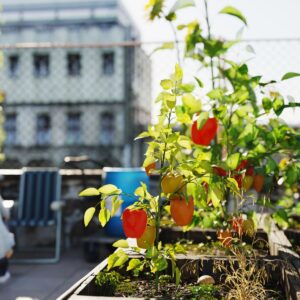
While you might think that “July” would be synonymous with “hot” or “sunshine” our summer has been sorely lacking in either of those. More than a month of near-daily rain has kept us damp and susceptible to powdery mildew, slugs, and failure to thrive. In spite of Mother Nature’s lack of cooperation, we are having some success. My son documented what’s going on out there at the moment. In spite of the weather we’re harvesting enough tomatoes for fresh eating from both in-ground plants and hanging tomatoes. The eggplant leaves are yellowing terribly – suggestions? Even with the yellowing leaves, I’m getting a decent crop of eggplant. This pepper plant was given to me by a neighbor. Not sure what it is, but it’s thriving here. It’s a bit spicy, and prolific. I’m discovering that finding plants that have traditionally done well here seems to be the ticket. (Note to self: stop experimenting!) But see, if I stopped experimenting I wouldn’t have discovered this pepper that’s putting on a nice show. (I believe it’s Lipstick from Baker Creek, but marauding chickens scratched up the plant markers.) I’m over the moon excited about growing Brussels sprouts. I’ve never grown them before and...

Sometimes you’ve just gotta get by with whatever works. Our front yard garden area is steep, as I’ve mentioned before. We’re planning to install rock walls, but so far it’s not exactly working out as planned. Last year at this time, my husband was working away from home so I tried my (failed) straw bale retaining wall experiment. This year, he’s battling a back injury and he hasn’t been exactly thrilled about hoisting rocks around. So, I came up with Plan C. I’m sure you’ve all seen the images of the vertical pallet garden floating around the web, right? Well, why not expand on that idea and use those pallets to retain the soil in my garden? I’m always willing to try something new - especially if it’s not going to cost me anything to try it – so I picked up a few pallets and brought them home. (There was only a little eye rolling from other members of the family.) We dug trenches about 18″ deep where we wanted the walls to be and then set a pallet into the trench with the boards situated horizontally. We filled the trench up, making sure to pack soil between the pallet boards, as...

Once upon a time, when I was a little girl, I proudly showed my grandma a wee sweet caterpillar. Instead of oohing and aahing over my find, Grandma snatched the wooly thing out of my hand and smashed it under foot. To her, it was simply a garden pest, but I was crushed. I like to think that I’d never do such a thing in front of a child, but I can and do handpick pests in the privacy of my own garden. Cabbage whites – more specifically, their caterpillars – are wreaking havoc on my kale and Brussels sprouts. The other day when a moth flew by, I did the logical thing and snatched it out of the air. There were no witnesses to my cruelty or to the fact that I’d snatched a moth right out of the air. I have turned into my Grandma, albeit a ninja version of my grandma. Cabbage whites are drawn to brassicas (cabbage, cauliflower, broccoli, bok choy, kale…). Getting these plants established in a garden can be difficult when a single caterpillar can decimate a young plant. While they’re small, consider covering the plants with some sort of mesh to keep the moths off...
Need to stretch your gardening space? We’ve all heard about going vertical, but here’s another way to take your garden to new heights. This tower garden uses less than one square foot of ground space and supports seventeen plants. I did this experimentally last year, planting basil and bok choy. The basil got a bit leggy after several months, but I think that’s my fault for being a little lax in caring for the tower. The bok choy worked beautifully. You’ll need: 8″ pvc pipe* (mine is just shy of 4′ in length and was scrounged from a construction site trash pile) 1-1/2″ hole saw potting soil seedlings (greens work well) Aim for four rows of four holes, equally spaced around the pipe. Stagger the holes to allow more space for each plant. Note that I did not do ANY measuring, but my holes are about 7″ apart. Two rows start about 7″ from the top of the pipe; the other two rows start about 3″ from the top of the pipe. The bottom of the pipe will have roughly 12″ of solid pipe. Dig a 12″ deep hole and bury the bottom of the pipe. Fill the inside...
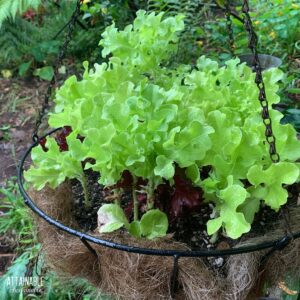
Unless you’re growing head lettuce, your greens can be a “cut and come again” crop. Instead of pulling the entire plant, thus ending the fresh salads, use scissors to cut off the outer leaves near the base of the plant. Leave the inner leaves intact and the entire plant will continue to grow. I’ve been harvesting my lettuce this way for a month and will continue to do so until the plant goes to seed. This is what my lettuce looked like before today’s harvest: This is what it looks like now: Within a week, it will look like that first picture again.
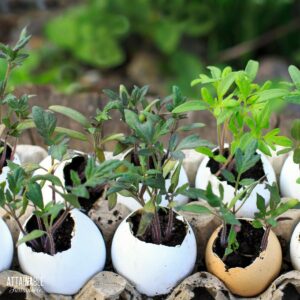
One of my readers, Ray, is trying valiantly to grow carefully chosen tomatoes from seed. But he’s getting frustrated: My plants were looking a little yellow so I figured they needed sun, but maybe I left them out too long. Some look basically dead…leaves are like blanched or something. How long does it take usually to get them used to the sun? Is it like an hour a day then two hours then 3 and so on or less/more? I feel frustrated because I put a lot of effort into selecting my seeds and getting the seed soil and everything else. I have my last bit of seeds in damp soil inside medium pots…I am pretty sure they are germinating…at this point are they better just planted outside you think?? Ray, tomatoes are something that I bought as plants for YEARS. If you’re new to gardening, I hate to see you frustrated trying to start tomatoes from seed. Do you have a local source for heirloom tomato plants? They’re more expensive, but way less frustrating! As far as seeds go, I’ve found that you really need to keep the seedlings at a consistent temperature with consistent moisture (maintain moisture...
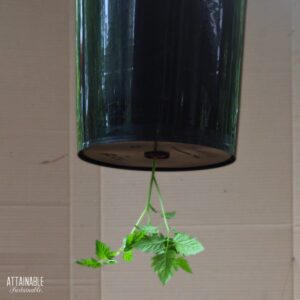
I posted earlier about my upside-down tomato experiment. After several months of growing, this is what it looks like: And here’s another plant, complete with ripening fruit: There is some slight browning on the edges of some of the leaves that I’m keeping my eyes on. I’m watering only about once a week, which surprises me. I’d expected this plant to dry out quickly, but so far that hasn’t been the case. I’m pleased enough with how it’s growing that I intend to plant a few more this way. Want to try it yourself? Instructions here.
We’ve already addressed the fact that I tend to try ridiculous crazy potentially clever ideas with abandon. So it will come as no surprise to many of you that when I finished peeling and juicing tangerines for my Tangerine Triple Sec, instead of composting the waste, I decided to try making vinegar. Tangerine vinegar? Yeah, that’s what I’m thinking. Ick. But worry not – I didn’t want to use it in the kitchen; my goal was to create a natural weed killer. In Wild Fermentation, Sandor Katz has a recipe for fruit scrap vinegar and, well, these were surely fruit scraps. I mixed the tangerine peels and the pulp in a big plastic container with about a gallon of water (enough to cover the fruit scraps) and one cup of sugar, stirring until the sugar dissolved. (Katz suggests 1/4 cup of sugar for each quart of water.) I covered the container with cheese cloth and set it out in my garage for about a month. Fruit flies managed to get into the container, but I since I didn’t plan to use this vinegar for cooking, I didn’t worry too much about them. After a month or so, the concoction...
I’ve been reading books to inspire my lifestyle lately and these really impressed me. Farm City: The Education of an Urban Farmer by Novella Carpenter The idea of creating a productive urban farm in the less desirable parts of Oakland, California is mind boggling to me. But while the location freaks me out a little – I’ve been lost in the seedier parts of Oakland. It is a scary place. – the story is an honest look at the author’s efforts to raise her own food. It’s not always pretty, but her determination and resourcefulness move her toward her goal and will certainly give those interested in adopting this sort of lifestyle an intimate look at what it’s like to raise poultry in a small space, scrounge for materials, and create something from nothing. When I mentioned this title on Facebook, The Metropolitan Homestead said: I’ve read it, and honestly, it was one of the things that pushed me into seriously starting our homesteading activities. I always wanted to get back to this lifestyle, but didn’t’ think we could in the city. Her book changed that mindset for me. The author has just released a second book, The Essential...