by Loku. Browse more infographics.
I’ve always taught my kids that dirt made their meals. I’ve discussed with them that they need to be able to trace their food back to dirt within three or four steps (milk comes from cows, who eat the grass, that grows in the dirt) to be sure they’re making good food choices. Now, Dirt! The Movie “tells the story of Earth’s most valuable and under-appreciated source of fertility–from its miraculous beginning to its crippling degradation.” It’s available on Netflix (currently as an instant play feature). I’ll be adding it to my queue.
In light of the fact that it’s International Composting Awareness Week it seems fitting to talk a little more about composting. What if you don’t have a lot of space for composting as Ruth commented awhile back? Your leftover salad greens, apple cores, egg shells, and gnarly vegetarian leftovers can go straight to the root of your garden when you use this method, which is ideal for urban gardeners. Toss compostable items into your blender so that it’s about a third full. Fill the container with water and blend until very finely chopped. Walk out to the garden and with a trowel, dig a small hole alongside a garden plant and pour some of the contents of the blender in. Cover with dirt and let the worms and microbes go to work. One blender full will fill three small holes (or, of course, one larger one). It’s so easy, I even did it single-handedly (LEFT-handedly) so I could take a video: Note: Only you know what your blender can handle. If you’re not sure if yours will tackle a whole, wilted sweet potato, you should probably skip it.
Over on the Attainable Sustainable Facebook page, I posted this video of Robyn O’Brien discussing America’s food system at TEDxAustin. It’s a very compelling video in which Ms. O’Brien offers a calm and concise look at the foods we’re feeding our families. For instance, did you know that genetically engineered corn is regulated by the EPA as an insecticide because it releases insecticides as it grows? Tortilla chips, anyone? After seeing the video, Sophia, one of my Facebook followers wrote: How can the average (poor) family of five eat on healthier food? I’m wanting to, but stumped. It’s a valid question. Learning about some of the atrocities in our supermarkets is the surest way to convince oneself that organic is the way to go. But organic food is expensive. It’s a sad day when food grown and prepared naturally is the alternative and not the norm, but that’s a whole ‘nother story. I live in a state that is notorious for its high food prices, so I’m all too aware just how costly it is to eat well on the cheap, but some of my tactics may work for you: Stop buying food products and start buying real food....
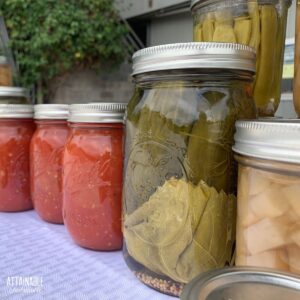
One of the primary reasons I garden is to fill my pantry with canned fruits and vegetables that are (almost*) free of bpa and pesticides. Of all the different things I preserve, tomatoes are far and away the most-used ingredients in my household; it seems I’m constantly pulling a jar of some sort of tomato product or another out of the pantry. In previous years, it’s been pints and quarts that I put up from our big California garden. I ran out of the canned goods I brought with me when we moved some time ago and I’m reduced to buying canned tomatoes – it’s killing me. (And yes, the movers DID think I was nuts. But I needed the jars; why not bring them full?) As the time for planting a garden nears, I’m gearing up to once again fill my pantry with tomatoes from the garden. In the past, I’ve planted as many as 40 tomato plants in a season and always had plenty for me as well as lots to share, but my space wasn’t nearly as limited. Here on this small lot where (ironically) full sun is scarce, there’s not room to wantonly plant excess....
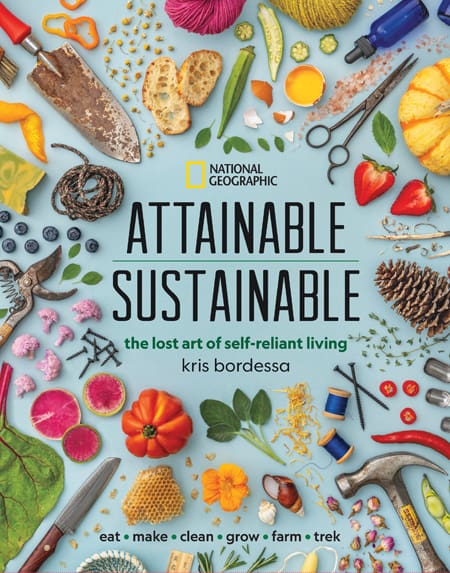
As more people become aware of the human impact on this earth (and ironically, on our own health) the idea of living a more sustainable, self-sufficient life is gaining ground. But. It’s one thing to think, “Hey, I’d love to be more self-sufficient!” and quite another to implement a lifestyle change that might require learning a new set of skills or two. Attainable Sustainable is about bridging the gap between wanting change and making it happen without becoming overwhelmed. Nobody’s saying you have to go get a tractor and a cow. As far as this site is concerned, sustainability is about eliminating excess and living lightly on the world. It’s about learning to generate food in a smart manner, whether that’s raising your own, joining a local CSA, or frequenting your local farmers markets. It’s about leaving the consumerism model behind and embracing the concept of re-purposing and reusing what we have. It’s discovering – one step at a time – how to make changes in your life to support a sustainable lifestyle. If you’re interested in making some positive changes in the way you live in this world, I hope you’ll stick around!